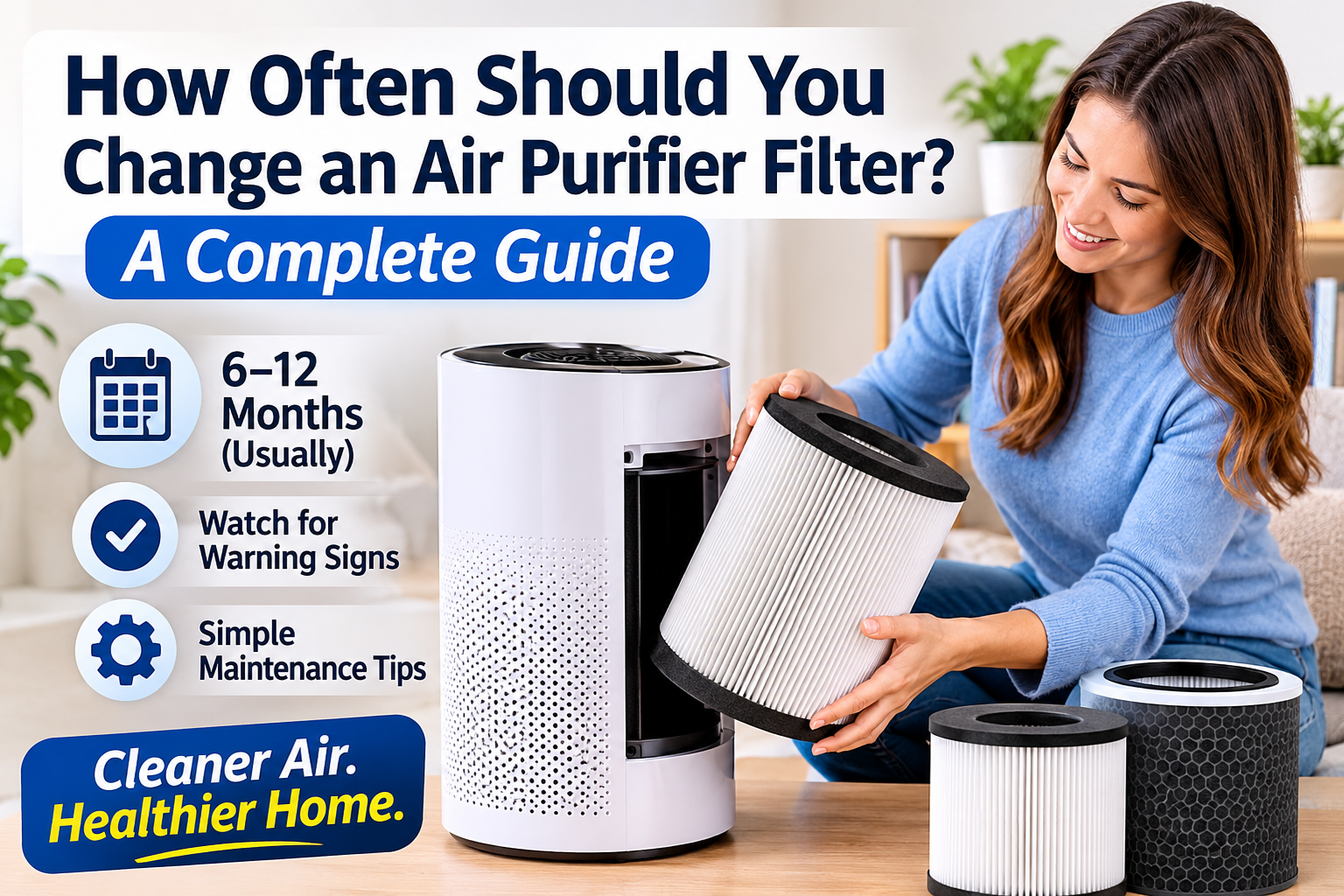
An air purifier can only do its job effectively when its filters are properly maintained. Over time, filters collect airborne particles, dust, pet dander, smoke, and other pollutants. As they become loaded with contaminants, airflow may decrease, and the purifier may not perform as intended.
So, how often should you change an air purifier filter?
For many residential air purifiers, the main filter replacement interval is approximately 6 to 12 months. However, that is only a general guideline. The actual schedule depends on your purifier model, filter type, operating hours, and indoor air quality.
Some filters need attention every few weeks, while others are designed to last much longer. Understanding these differences can help you avoid unnecessary replacements and keep your air purifier operating as intended.
In this guide, we’ll explain how often to replace different filter types, which warning signs to watch for, and how to choose the correct replacement filter.
How Often Should You Change an Air Purifier Filter?
Most residential air purifier filters need to be replaced according to the manufacturer’s recommended schedule. For many models, the main particle filter lasts around 6 to 12 months under typical household conditions.
However, there is no single replacement schedule that applies to every air purifier.
A purifier running continuously in a home with pets may need more frequent maintenance than one operating occasionally in a relatively clean room. Similarly, homes exposed to wildfire smoke, heavy dust, or indoor smoking may place additional demands on filtration media.
Here is a general maintenance reference:
| Filter type | General maintenance guidance |
|---|---|
| Washable pre-filter | Inspect and clean regularly, often every 2–4 weeks |
| HEPA or particle filter | Commonly replaced every 6–12 months, depending on the model |
| Activated carbon filter | Replacement timing varies with carbon quantity, use, and odor exposure |
| Permanent filter | Follow the manufacturer’s cleaning and maintenance instructions |
These are general reference ranges, not universal product specifications. Always check the manual for your exact air purifier.
Why Is There No Universal Replacement Schedule?
Air purifier filters are not all made from the same materials, and manufacturers design their products differently.
A filter’s lifespan can depend on:
- The amount of filtration material inside it.
- How much air passes through the purifier.
- The concentration of particles and pollutants in the room.
- Whether the purifier runs continuously or occasionally.
- The design of the pre-filter and main filtration system.
For this reason, a replacement interval advertised for one model should not automatically be applied to another model—even if both use HEPA filtration.
How Often Should You Replace Different Types of Air Purifier Filters?
Understanding the type of filter in your purifier is the first step toward maintaining it correctly.
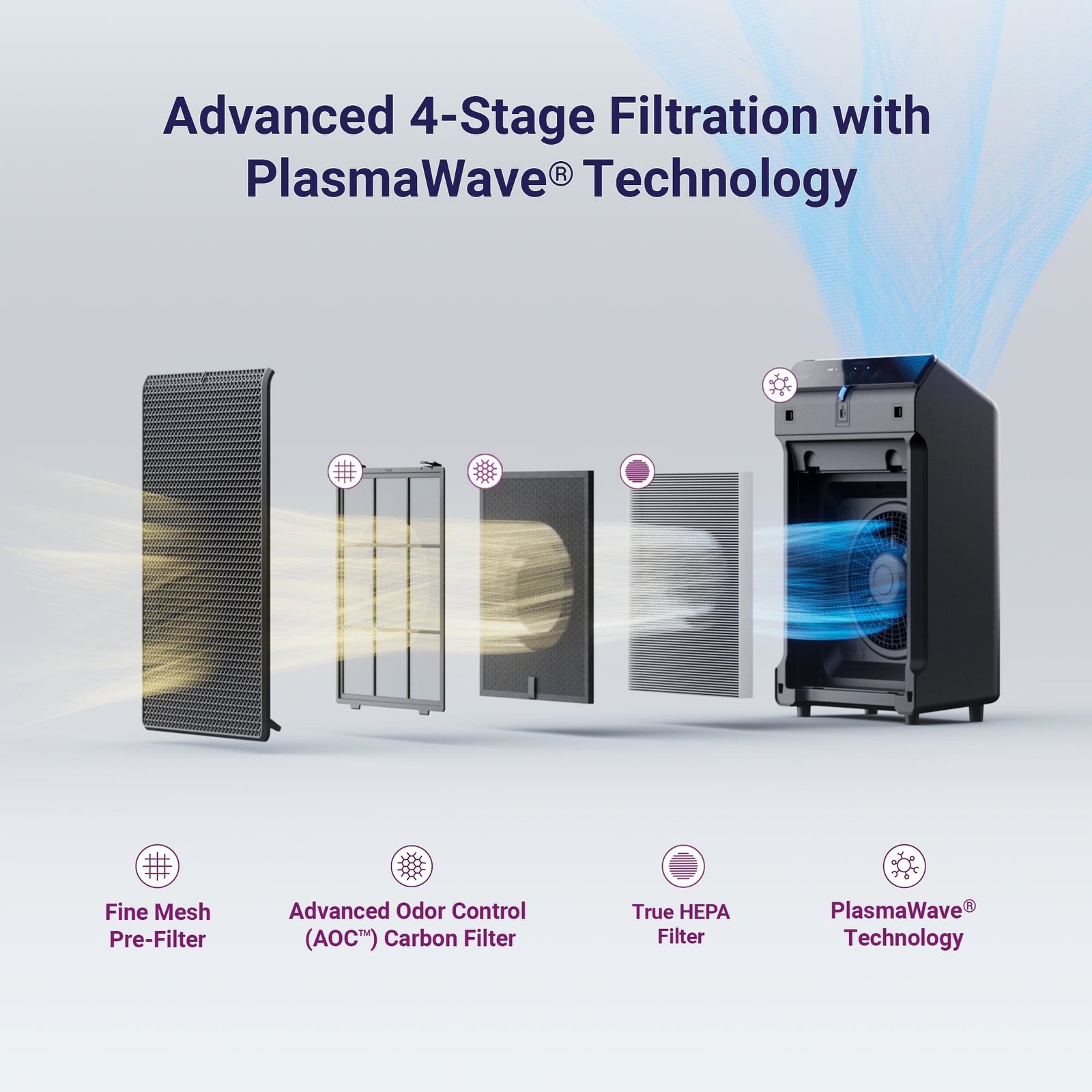
Most residential air purifiers use one or more of the following filter types.
1. HEPA Filters
High-Efficiency Particulate Air (HEPA) filters are designed to capture airborne particles, including dust, pollen, and other fine particles.
Many residential air purifiers recommend replacing their main HEPA-style or particle filters approximately every 6–12 months. Some models have shorter or longer schedules.
The actual lifespan depends on the filter design and how heavily the purifier is used.
When to consider replacement:
- The manufacturer’s recommended replacement interval has arrived.
- The replacement indicator signals that the filter is due.
- The filter is visibly damaged.
- Airflow or performance changes suggest a maintenance issue.
One important point: Do not assume that a HEPA filter can be washed or vacuumed. Most conventional HEPA filters are not washable. Cleaning them incorrectly can damage the filter media.
2. Activated Carbon Filters
Activated carbon filters are commonly used to reduce certain odors and gases from indoor air.
Unlike particle filters, which physically capture airborne particles, activated carbon works through adsorption. Pollutants interact with the carbon’s porous surface and become retained within the material.
Carbon filter lifespan varies considerably. It depends on the amount and type of carbon, the pollutants present, and how much air passes through the filter.
A carbon filter exposed to persistent cooking odors, tobacco smoke, or other strong smells may lose its usefulness sooner than one operating in a cleaner environment.
When to consider replacement:
- Odors begin returning despite normal purifier operation.
- The manufacturer’s replacement interval has arrived.
- The carbon filter is damaged or visibly deteriorated.
- The manufacturer indicates that the filter has reached the end of its service life.
Keep in mind that a carbon filter does not remove every gas or chemical under every condition. Its effectiveness depends on the specific filter design and the pollutant involved.
3. Pre-Filters
Pre-filters capture larger particles such as hair, lint, and visible dust before air reaches the main filtration stages.
Because they handle larger debris, pre-filters often need attention more frequently than HEPA filters.
Some are washable, while others are designed for vacuum cleaning or replacement. The correct method depends on the product.
For washable pre-filters, a general inspection and cleaning routine every 2–4 weeks can be a useful starting point. Homes with pets or heavy dust may require more frequent attention.
How to maintain a washable pre-filter:
- Turn off and unplug the air purifier.
- Remove the pre-filter according to the manufacturer’s instructions.
- Check whether the filter is washable or vacuum-only.
- Clean it using the recommended method.
- Allow a washable filter to dry completely before reinstalling it.
- Reinstall it correctly and check that the purifier operates normally.
Never wash a filter simply because it looks like a washable mesh. Confirm the instructions first.
4. Washable and Permanent Filters
Some air purifiers use permanent or washable filtration components. These are designed to be maintained rather than replaced on a conventional schedule.
However, permanent does not mean maintenance-free.
Dust and debris can still accumulate, and cleaning instructions vary between products. Some washable components must be completely dry before installation. Others may require a specific cleaning method.
Follow the product manual rather than applying cleaning instructions from another purifier.
Air Purifier Filter Replacement Schedule by Brand
Different manufacturers use different filter designs and replacement recommendations. Even within the same brand, schedules can vary by model.
Here is how to approach some popular air purifier brands.
Levoit
Levoit provides model-specific replacement guidance for its air purifiers. Some models commonly recommend replacing their main filters after approximately 6–8 months under normal use.
However, the correct interval depends on the exact model and operating conditions.
Before ordering a replacement, check your purifier’s model number and the compatible filter part number.
Blueair
Blueair uses different filter designs across its product range. Certain models include filter-life indicators that help users determine when replacement is due.
Some Blueair filters are designed for approximately 6–12 months of use, but the actual recommendation depends on the model and usage conditions.
Check the product manual or official support information for your specific purifier.
Coway
Coway offers several air purifier models with different filter configurations.
Its replacement schedules can vary substantially between pre-filters, deodorization filters, and particle filters. Some components require frequent cleaning, while others have longer replacement intervals.
Do not assume that every Coway filter should be replaced at the same time.
Honeywell
Honeywell also uses different filter designs across its air purifier range.
Some models have washable pre-filters, while others use replaceable HEPA and odor-reducing filters. Replacement timing depends on the product series and filter type.
Check the instructions for your exact Honeywell model before purchasing replacement filters.
Important: Brand-level schedules are only a starting point. The manufacturer’s current documentation for your exact model should always take priority.
7 Signs Your Air Purifier Filter Needs Replacing
A filter does not always stop working suddenly. In many cases, there are warning signs that maintenance or replacement may be necessary.
Here are seven things to watch for.
1. Reduced Airflow
If your purifier seems to move less air than usual, a clogged filter could be one possible cause.
However, reduced airflow can also result from blocked air inlets, dirty pre-filters, or other mechanical issues.
Inspect the purifier before assuming the main filter needs replacement.
2. The Filter Replacement Indicator Turns On
Many modern air purifiers include a filter replacement indicator.
Depending on the model, this indicator may estimate filter life using operating hours, usage patterns, or other information.
When the alert appears, consult the manual. Some models require you to reset the indicator after installing a new filter.
Remember that an indicator is a maintenance aid, not necessarily a direct measurement of the filter’s remaining filtration capacity.
3. Visible Dust and Buildup
A heavily loaded pre-filter may show visible dust, hair, and lint.
This is often a sign that the pre-filter needs cleaning.
For a sealed HEPA filter, visible dust alone does not always mean it must be replaced immediately. Use the manufacturer’s maintenance schedule and inspection instructions.
4. Persistent Odors
If unpleasant odors return while the purifier is operating normally, the activated carbon filter may have reached the end of its useful life.
First, consider whether the odor source is still present in the room. A purifier cannot eliminate every odor or compensate for an ongoing pollution source.
5. Unusual Performance Changes
If the purifier behaves differently from normal, inspect the filter and other components.
A poorly installed filter, blocked air intake, or maintenance issue may affect operation.
6. The Filter Is Damaged
Cracks, tears, damaged seals, or deformed filter material can compromise proper filtration.
A damaged filter should be handled according to the manufacturer’s replacement guidance.
7. The Recommended Replacement Date Has Arrived
Even if a filter looks relatively clean, it may have reached its recommended service interval.
Some pollutants are not visible, and a visual inspection cannot reliably measure remaining filter capacity.
Use the manufacturer’s schedule as your primary reference.
What Affects Air Purifier Filter Lifespan?
Several factors influence how long an air purifier filter remains useful.
Pets and Pet Dander
Homes with dogs and cats often have additional airborne hair, dander, and dust.
These particles can load a pre-filter more quickly, making regular inspection particularly important.
If you have multiple pets, check your purifier’s pre-filter more frequently than the standard household schedule.
Wildfire Smoke
Wildfire smoke can introduce fine particles and other pollutants into indoor environments.
During periods of heavy smoke exposure, an air purifier may need to operate for longer periods and process more polluted air.
Check the filter and follow the manufacturer’s replacement guidance after prolonged smoke events.
Dust and Construction
Home renovation, sanding, construction, and nearby dust sources can increase the particle load inside a room.
During these periods, pre-filters may require more frequent cleaning.
If construction work is taking place, avoid exposing the purifier to excessive dust beyond the operating conditions recommended by its manufacturer.
Cigarette Smoke and Cooking
Indoor smoking and cooking can introduce particles and odors into the air.
A purifier with an appropriate particle filter and activated carbon component may help reduce certain pollutants, but filter capacity is limited.
Persistent exposure can increase maintenance demands.
Daily Operating Hours and Fan Speed
A purifier that runs continuously processes more air than one used for only a few hours each day.
Fan speed also affects airflow through the filter.
These factors can influence filter life, which is why manufacturer recommendations should be interpreted in the context of actual use.
Can You Clean or Wash an Air Purifier Filter?
The answer depends on the filter type.
Some pre-filters are washable, while many HEPA and activated carbon filters are designed to be replaced.
Using the wrong cleaning method can damage a filter or reduce its effectiveness.
Can You Wash a HEPA Filter?
In most residential air purifiers, conventional HEPA filters should not be washed.
Water can damage the filter media, and improper cleaning may affect its filtration performance.
There are washable or reusable filtration products on the market, but they are not interchangeable with conventional HEPA filters.
Always check the manufacturer’s instructions for your exact model.
Can You Vacuum an Air Purifier Filter?
Some manufacturers permit gentle vacuuming of specific pre-filters.
However, vacuuming a conventional HEPA filter is generally not recommended unless the manufacturer explicitly allows it.
A vacuum cleaner can damage delicate filter material or disturb captured particles.
How Often Should You Clean a Pre-Filter?
For many washable or reusable pre-filters, inspecting them every 2–4 weeks is a practical starting point.
You may need to clean them more frequently if you have pets, live in a dusty area, or operate the purifier continuously.
The exact schedule depends on the product.
How to Choose the Right Replacement Air Purifier Filter
Buying a replacement filter is not simply a matter of choosing one that looks similar to your existing filter.
Compatibility is essential.
1. Check Your Exact Purifier Model
Find the model number on the purifier itself, its packaging, or the original documentation.
Two products from the same brand may use completely different filters.
2. Match the Filter Part Number
Look for the replacement part number recommended by the manufacturer.
A filter that physically fits may still differ in material, construction, or performance.
3. Compare Genuine and Third-Party Filters
Genuine replacement filters are designed for the manufacturer’s product specifications.
Third-party filters may offer lower prices, but quality and compatibility can vary.
Before purchasing, check:
- Exact model compatibility.
- Filter dimensions and sealing design.
- Material and construction information.
- Seller reputation.
- Return and warranty policies.
- Whether performance claims are independently supported.
Avoid relying on vague labels such as “HEPA-style” as proof that a replacement meets a particular filtration standard.
4. Consider Long-Term Replacement Costs
The initial price of an air purifier is only one part of its ownership cost.
If a model requires expensive replacement filters several times a year, the long-term cost may be higher than expected.
Before buying a purifier, compare:
- Replacement filter prices.
- Recommended replacement intervals.
- Number of filters required.
- Availability of genuine replacements.
- Shipping costs and availability.
A purifier with a reasonable purchase price but expensive replacement filters may not be the most economical option over time.
Frequently Asked Questions
1. How often should I change my air purifier filter?
Many residential air purifiers recommend replacing their main filters approximately every 6–12 months. However, the correct interval depends on the purifier model, filter type, operating hours, and indoor air quality.
Always follow the manufacturer’s instructions.
2. How long does a HEPA air purifier filter last?
A HEPA filter in a residential air purifier may last around 6–12 months, although some models have different schedules.
Heavy use, smoke, dust, and other environmental conditions can affect its lifespan.
3. Can I wash an air purifier HEPA filter?
Most conventional HEPA filters are not washable. Washing them can damage the filter media.
Only clean a filter if the manufacturer specifically identifies it as washable and provides cleaning instructions.
4. What happens if I don’t change my air purifier filter?
An overdue or overloaded filter may restrict airflow and reduce the purifier’s ability to operate as intended.
It can also increase maintenance demands. Follow the replacement schedule and inspect the filter regularly.
5. How do I know when my air purifier filter needs replacing?
Check the filter indicator, manufacturer’s recommended interval, filter condition, and any unusual changes in airflow or odor.
No single sign reliably measures the remaining filtration capacity of every filter.
6. Do air purifier filters last longer if the purifier runs less often?
Generally, fewer operating hours mean less air passes through the filter. This may reduce the rate at which particles accumulate.
However, actual filter life also depends on indoor pollution levels and the filter design.
7. Should I replace my carbon filter and HEPA filter at the same time?
Not necessarily.
Some air purifiers use combined filter cartridges, while others have separate components with different replacement schedules.
Follow the instructions for your particular model.
8. Can I vacuum an air purifier filter?
Some pre-filters can be vacuumed if the manufacturer allows it. Conventional HEPA filters generally should not be vacuumed unless the product instructions specifically permit it.
Final Thoughts
Changing an air purifier filter at the right time is an important part of maintaining indoor air quality.
For many residential models, 6–12 months is a useful starting reference for the main filter. But the right replacement schedule depends on the purifier, filter design, operating conditions, and indoor environment.
Check the pre-filter regularly, pay attention to replacement indicators, and use the correct replacement part for your exact model.
Most importantly, don’t assume that every filter can be washed or that every purifier follows the same maintenance schedule.
A little attention to filter maintenance can help your air purifier operate as intended and make long-term ownership easier to manage.
Kamal Kishor Raika
BestAirPurifierOnline.com