Blueair Air Purifier Review: Is Blueair Worth the Price?
Author: Kamal Kishor Raika
Blueair has become a recognizable name in the air purifier market, particularly for its HEPASilent filtration technology, minimalist designs, and emphasis on quiet operation. Its Blue Pure series includes compact models for bedrooms and larger units designed for living rooms and open spaces.
But are Blueair air purifiers worth their premium price? Does HEPASilent technology offer meaningful advantages over conventional filtration? And how do popular models such as the Blue Pure 311i Max and 211i Max compare with competitors from Coway and Levoit?
In this Blueair air purifier review, we examine the brand’s filtration technology, popular US models, CADR ratings, noise levels, replacement-filter costs, smart features, and potential limitations.
Our goal is to help you decide whether a Blueair purifier is the right investment for your home.
Blueair Brand Overview
Blueair is an air purification brand known for combining filtration technology with modern product design. Its products are available in several categories, including compact bedroom purifiers and larger units for spacious living areas.
The Blue Pure series is particularly recognizable for its fabric pre-filters, cylindrical or rectangular designs, and relatively simple controls.
Depending on the model, Blueair air purifiers may include:
- HEPASilent filtration technology.
- Washable fabric pre-filters.
- Particle and carbon combination filters.
- Built-in air-quality sensors.
- Automatic fan-speed adjustment.
- Smartphone app connectivity.
- Filter replacement indicators.
Not every Blueair model includes the same features. Connectivity, filtration design, room coverage, and replacement-filter compatibility vary across product generations.
Blueair’s main selling point is its HEPASilent technology, which combines mechanical and electrostatic filtration. Understanding this technology is important before comparing the brand with conventional HEPA-based air purifiers.
What Is HEPASilent Technology?
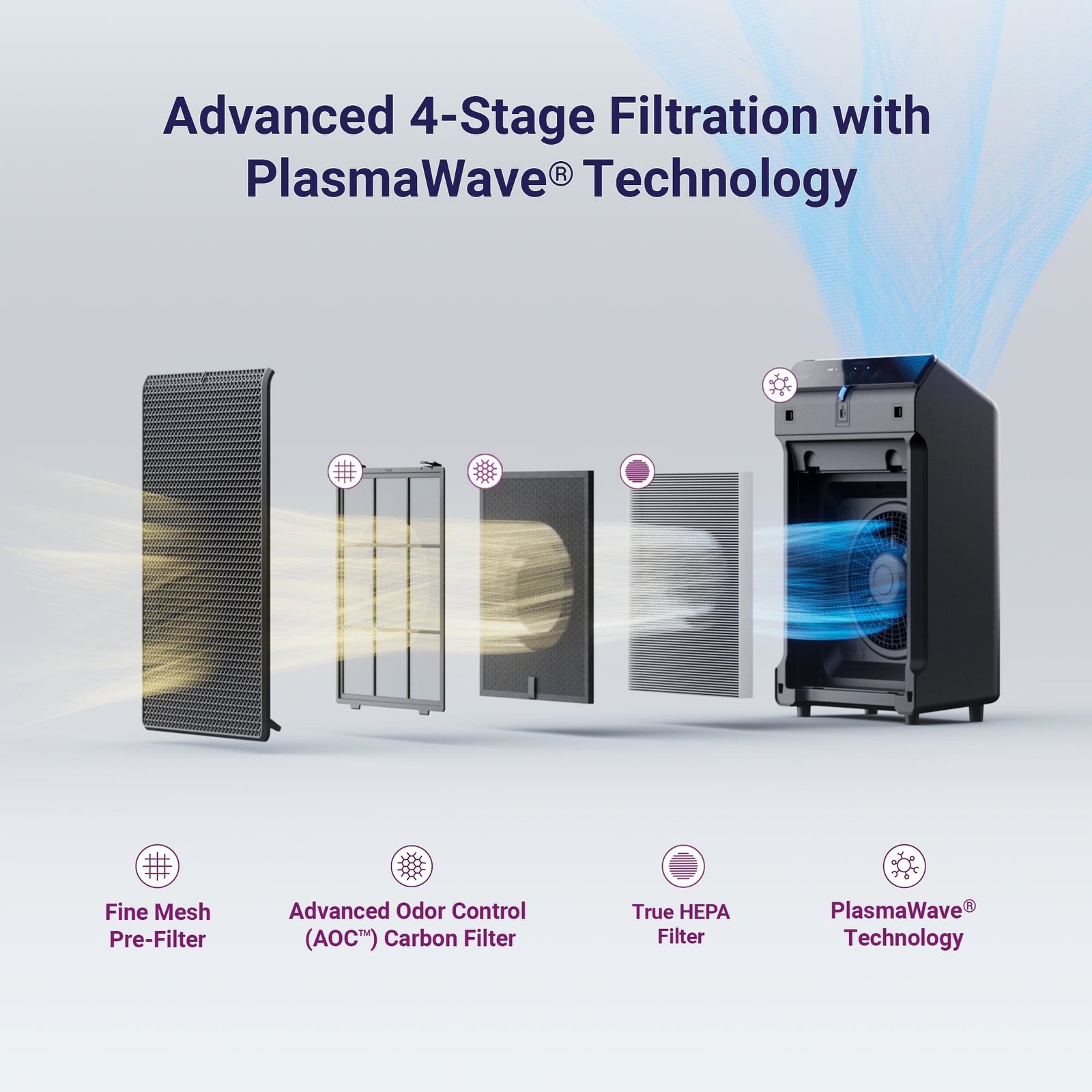
HEPASilent is Blueair’s proprietary air-cleaning technology. It combines mechanical filtration with electrostatic technology to capture airborne particles.
In a conventional mechanical filtration system, air passes through filter media that physically captures particles. Blueair’s HEPASilent approach adds an electrostatic component to the filtration process.
The intended benefit is effective particle removal while maintaining strong airflow and relatively low noise.
Mechanical and Electrostatic Filtration
HEPASilent technology uses two complementary approaches:
Mechanical filtration: Filter media captures airborne particles as air passes through the purifier.
Electrostatic technology: An electrical component helps charge particles, supporting their capture by the filtration media.
This combination is designed to balance filtration performance, airflow, and noise.
However, buyers should understand that HEPASilent is Blueair’s proprietary technology. It should not automatically be described as identical to a conventional mechanical True HEPA filter.
How HEPASilent Differs from Conventional HEPA Filtration
A conventional True HEPA filter meeting the commonly cited US definition captures at least 99.97% of particles measuring 0.3 microns under specified test conditions.
Blueair’s HEPASilent technology uses a different filtration approach that combines mechanical and electrostatic elements.
The important buying question is not simply whether a purifier uses the word HEPA. It is how effectively the complete system removes particles under relevant test conditions.
When comparing Blueair with other brands, look for:
- Independent particle-removal measurements.
- CADR ratings.
- Room coverage at a clearly stated air-change rate.
- Filter replacement requirements.
- Emissions and certification information.
Filtration Performance and Limitations
Blueair’s filtration technology is primarily intended to reduce airborne particles.
Depending on the filter configuration, its purifiers may help reduce:
- Dust.
- Pollen.
- Pet dander.
- Fine airborne particles.
- Smoke particles.
- Certain household odors.
Activated carbon can adsorb certain gases and odors, but its effectiveness depends on the amount and type of carbon, airflow, and pollutant concentration.
A purifier with a relatively small carbon component should not be expected to remove every VOC or gaseous pollutant.
Popular Blueair Air Purifier Models
Blueair offers several models for different room sizes. The following products are useful starting points when comparing the brand’s US lineup.
1. Blue Pure 411i+ Max
The Blue Pure 411i+ Max is a compact option designed for smaller rooms.
Its manufacturer-published specifications include:
- Recommended room size: 259 square feet.
- Smoke CADR: 167 CFM.
- Noise range: 19–46 dB.
- Energy consumption: 20 W.
Its compact footprint makes it worth considering for bedrooms, smaller home offices, and other spaces where a larger purifier may be unnecessary.
The model includes smart features associated with Blueair’s Max series, although buyers should check the current product documentation for exact connectivity and control options.
Best for: Buyers who need a compact purifier for a smaller room and want to consider Blueair’s HEPASilent technology.
2. Blue Pure 311i Max
The Blue Pure 311i Max is designed for medium-sized rooms and is one of the more interesting models in Blueair’s lineup.
Manufacturer-published specifications include:
- Recommended room size: 439 square feet.
- Smoke CADR: 283 CFM.
- Noise range: 23–50 dB.
- Energy consumption: 32 W.
Independent testing adds useful context.
HouseFresh reported the following results for the 311i Max:
| Measurement | Reported result |
|---|---|
| PM1 CADR at maximum speed | 220 CFM |
| PM1 CADR below 45 dBA | 108 CFM |
| Lowest measured noise | 34.9 dBA |
| Highest measured noise | 57.7 dBA |
| Maximum power consumption | 29.2 W |
These are HouseFresh’s independent measurements, not manufacturer specifications or AHAM smoke CADR figures.
The difference between manufacturer-rated CADR and independent PM1 CADR is not necessarily a contradiction. The measurements can use different particle categories, testing methods, and conditions.
One limitation highlighted by HouseFresh is that the 311i Max’s integrated ionization cannot be independently disabled. Buyers who specifically want a mechanical-only purifier should consider this before purchasing.
Best for: Buyers looking for a medium-room purifier with smart features and strong reported particle-removal performance.
3. Blue Pure 311i+ Max
The Blue Pure 311i+ Max is positioned for medium-to-larger rooms.
Its published specifications include:
- Recommended room size: 525 square feet.
- Smoke CADR: 339 CFM.
- Noise range: 23–50 dB.
- Energy consumption: 38 W.
It offers a higher airflow rating than the 311i Max and may be worth considering when the room is larger or when a higher clean-air delivery rate is needed.
However, the room-size rating should always be interpreted alongside its air-change assumption.
For buyers who want to operate a purifier at a quieter speed, the available CADR at that speed matters more than the maximum rating alone.
Best for: Buyers who need more airflow than the smaller Blue Pure models offer.
4. Blue Pure 211i Max
The Blue Pure 211i Max is one of Blueair’s larger residential models.
Its manufacturer-published specifications include:
- Recommended room size: 674 square feet.
- Smoke CADR: 435 CFM.
- Noise range: 23–53 dB.
- Energy consumption: 46 W.
The higher CADR makes it a stronger candidate for large rooms and open living spaces.
The 211i Max is also available with different replacement-filter options, including Particle & Carbon, AllergenBlock, and SmokeBlock filters.
Its larger airflow capacity is useful, but the purifier also requires more physical space than compact models.
Best for: Buyers who need higher airflow for a large living room or spacious shared area.
Which Blueair Model Should You Choose?
The right model depends on your room size, desired air-change rate, noise preference, and budget.
| Model | Manufacturer room-size rating | Smoke CADR |
|---|---|---|
| 411i+ Max | 259 sq. ft. | 167 CFM |
| 311i Max | 439 sq. ft. | 283 CFM |
| 311i+ Max | 525 sq. ft. | 339 CFM |
| 211i Max | 674 sq. ft. | 435 CFM |
These figures are manufacturer-published ratings. They should not be interpreted as a guarantee of identical cleaning performance in every room.
For a fair comparison, check the ACH assumption behind each room-size rating.
Blueair CADR and Room Coverage
CADR stands for Clean Air Delivery Rate. It indicates how quickly an air purifier supplies filtered air for particular particle categories.
In the United States, AHAM commonly reports CADR ratings for:
- Smoke.
- Dust.
- Pollen.
A higher CADR generally indicates a greater clean-air delivery rate under the applicable test conditions.
However, room coverage is not a universal number. It depends on room volume and the number of air changes per hour.
For example, a purifier rated for a large room at one air change per hour may not deliver the same performance at four or five air changes per hour.
A useful formula is:
Required CADR (CFM) = Room Volume (cubic feet) × Desired ACH ÷ 60
Before choosing a Blueair model:
- Measure the room’s floor area.
- Estimate ceiling height.
- Calculate the room volume.
- Decide on a suitable air-change target.
- Compare the required airflow with the purifier’s CADR.
For more information, read our guide to understanding CADR ratings.
Noise Levels and Energy Consumption
Noise is an important consideration when buying an air purifier.
A machine may deliver excellent performance at maximum speed, but if it becomes too loud for a bedroom or home office, you may end up operating it at a lower setting.
Blueair publishes noise ranges for its products. For example, the 311i Max is listed at 23–50 dB, while the 211i Max is listed at 23–53 dB.
Independent testing of the 311i Max by HouseFresh reported a noise range of approximately 34.9–57.7 dBA.
These numbers should not be directly mixed because the measurement conditions and methods may differ.
When comparing noise, consider:
- Noise at the lowest fan setting.
- Noise at a comfortable sleeping speed.
- CADR available below a chosen noise threshold.
- Whether automatic mode changes fan speed frequently.
Energy Consumption
Blueair’s published power consumption varies by model.
| Model | Published power consumption |
|---|---|
| 411i+ Max | 20 W |
| 311i Max | 32 W |
| 311i+ Max | 38 W |
| 211i Max | 46 W |
Actual electricity use depends on the selected fan speed, operating schedule, and household electricity supply.
A simple way to estimate consumption is:
Daily energy use (kWh) = Power (W) × Operating hours ÷ 1,000
For example, a purifier operating continuously at a constant 32 W would consume approximately 0.768 kWh per day.
Actual use may be lower or higher depending on fan settings and operating conditions.
Ozone, Ionization, and Safety Considerations
Ionization and ozone are important topics when evaluating air purifiers.
Some air-cleaning technologies use electrical processes to charge airborne particles. Depending on the technology and design, these processes may generate ozone as a byproduct.
Ozone can irritate the respiratory system, particularly at elevated concentrations.
Blueair’s HEPASilent technology incorporates electrostatic elements. Buyers who are concerned about ozone should review the exact model’s emissions documentation and relevant third-party certification information.
There is also an important model-specific consideration.
HouseFresh reported that the ionization function on the Blue Pure 311i Max cannot be independently disabled.
This is different from an air purifier that offers a separate ionizer switch.
Do not assume that every Blueair model has identical controls or emissions characteristics. Check the official documentation for the exact model you are considering.
For buyers who specifically prefer mechanical-only filtration, conventional HEPA purifiers without integrated ionization may be more appropriate.
Blueair Replacement Filters and Maintenance
Replacement filters are a major part of the long-term cost of owning an air purifier.
Blueair sells model-specific replacement filters through its official store. Different filters may be available for particle filtration, odor reduction, and specialized applications.
Particle & Carbon Filters
Particle & Carbon filters combine particle filtration with activated carbon.
They are intended to capture airborne particles while helping reduce certain household odors and gases.
The actual gas-removal performance depends on the carbon material and quantity.
AllergenBlock and SmokeBlock Filters
Blueair offers specialized filter options for selected models.
These may include:
- AllergenBlock filters.
- SmokeBlock filters.
- Standard Particle & Carbon filters.
The availability and compatibility of each filter depend on the purifier model.
Do not assume that a filter designed for the 311i+ Max will fit the 211i Max or another Blueair generation.
Replacement Filter Costs
The following are approximate official-store prices observed during research. Prices can change, so verify them before purchasing.
| Model | Particle & Carbon | AllergenBlock | SmokeBlock |
|---|---|---|---|
| 311i+ Max | $49.99 | $69.99 | $64.99 |
| 211i Max | $69.99 | $89.99 | $84.99 |
The 211i Max manual indicates that its main filter generally needs replacement after approximately 6–9 months, depending on usage and air quality.
Actual filter life can vary considerably.
Before buying, calculate the annual replacement-filter cost rather than focusing only on the purifier’s initial purchase price.
How to Maintain a Blueair Air Purifier
A practical maintenance routine includes:
- Inspect the fabric pre-filter regularly.
- Wash the fabric pre-filter according to the manual.
- Allow the fabric to dry completely before reinstalling it.
- Replace the main filter according to model-specific guidance.
- Keep air inlets and outlets unobstructed.
- Clean the sensor area when instructed by the manufacturer.
- Reset the filter indicator after replacement, following the manual.
Never wash the main disposable filter unless Blueair explicitly identifies it as washable.
Smart Features and App Experience
Selected Blueair Max models offer smartphone connectivity and automatic operation.
Depending on the model, features may include:
- Remote operation.
- Fan-speed adjustment.
- Automatic mode.
- Air-quality information.
- Filter replacement notifications.
- Scheduling and other app controls.
These features can be useful when you want to manage a purifier without physically interacting with it.
However, not every Blueair model offers the same app experience.
Before purchasing, check the exact model’s supported features, Wi-Fi requirements, app compatibility, and available air-quality measurements.
Also remember that a built-in air-quality sensor measures only the pollutants it is designed to detect. It should not be treated as a complete indoor air-quality monitoring system.
Blueair Air Purifier Pros and Cons
Pros
- HEPASilent technology combines mechanical and electrostatic filtration.
- Strong manufacturer-published CADR ratings on selected models.
- Independent testing reports good particle-removal performance for the 311i Max.
- Several models are designed for relatively quiet operation.
- Washable fabric pre-filters on selected products.
- Smartphone connectivity on compatible models.
- Different replacement-filter options for selected products.
- Multiple sizes for bedrooms and larger living spaces.
Cons
- Integrated ionization may not suit buyers who prefer mechanical-only filtration.
- Some models do not allow ionization to be independently disabled.
- Replacement filters can add significant long-term costs.
- Filter compatibility differs between models.
- Maximum-speed operation can be noticeably louder.
- Carbon filtration capacity varies by replacement-filter type.
- Premium models may cost more than competing alternatives.
Blueair vs. Coway vs. Levoit: Which Brand Is Better?
Blueair, Coway, and Levoit are all worth considering, but they use different product designs and feature combinations.
The best choice depends on the individual model rather than the brand name alone.
| Buying factor | Blueair | Coway | Levoit |
|---|---|---|---|
| Filtration approach | HEPASilent on selected models | Model-specific HEPA systems | Model-specific filtration |
| Smart features | Available on selected models | Model-dependent | Available on selected models |
| Design | Fabric pre-filter options | Traditional and modern designs | Broad range of designs |
| Particle performance | Strong results in selected models | Strong results in selected models | Model-dependent |
| Filter costs | Vary by model and filter type | Vary by model | Vary by model |
| Main consideration | Electrostatic technology and filter cost | CADR, features, and maintenance | Model-specific filtration and value |
Blueair vs. Coway
Blueair may appeal to buyers who like HEPASilent technology, modern designs, and smart features on selected models.
Coway may appeal to buyers who prefer its established Airmega designs and mechanical filtration systems.
The original Coway Mighty and Blueair 311i Max should be compared using measured particle performance, operating noise, and long-term filter costs.
Read our Coway air purifier review for a closer look at Coway’s Airmega models.
Blueair vs. Levoit
Levoit offers a wide selection of air purifiers, including compact models and larger units with smart features.
Blueair differentiates itself through HEPASilent technology and its product design.
When comparing these brands, check the exact filter classification, CADR, room coverage assumptions, noise, and replacement-filter availability.
Read our Levoit air purifier review for more details.
Which Brand Should You Choose?
Choose based on your actual requirements:
- Consider Blueair if you value its HEPASilent approach and the features of its Max series.
- Consider Coway if an Airmega model meets your room’s airflow requirements and you prefer its filtration design.
- Consider Levoit if its model range, features, and replacement-filter costs better match your budget.
There is no universal winner across all room sizes and budgets.
Who Should Buy a Blueair Air Purifier?
A Blueair air purifier may be worth considering if:
- You want a purifier with strong particle-filtration performance.
- You like the HEPASilent filtration approach.
- You want a modern design with a fabric pre-filter.
- You need a model for a medium or large room.
- You value smart features on compatible models.
- You are comfortable with model-specific replacement-filter costs.
- You have checked the ionization and emissions details for your selected model.
The 311i Max and 211i Max are particularly useful models to compare when evaluating medium and large room requirements.
Who Should Consider Other Brands?
Blueair may not be the right choice if:
- You specifically want a mechanical-only purifier without integrated ionization.
- You require an independently switchable ionizer function.
- Replacement-filter costs are a major concern.
- You need substantial gas or VOC removal from a large quantity of activated carbon.
- You want a very simple purifier without app connectivity.
- Another brand offers better CADR at your preferred noise level and budget.
In these situations, compare individual models from Coway, Levoit, and other manufacturers before making a decision.
Is Blueair Worth the Price? Our Verdict
Blueair offers an interesting combination of filtration technology, product design, and smart features.
Its HEPASilent approach distinguishes it from conventional mechanical-only air purifiers, while models such as the Blue Pure 311i Max and 211i Max offer substantial manufacturer-published CADR ratings.
Independent testing also provides useful evidence of the 311i Max’s particle-removal performance.
However, Blueair is not automatically the best option for every household.
Buyers should pay particular attention to integrated ionization, replacement-filter prices, and the difference between maximum-speed performance and quieter everyday operation.
Our verdict: Blueair is worth considering if you value its filtration approach, design, and available features. But compare its total ownership cost and independently measured performance with Coway and Levoit before paying a premium.
The best purifier is the one that delivers sufficient clean air for your room, at a noise level you can tolerate, with replacement filters you can afford.
Frequently Asked Questions
1. Is Blueair a good air purifier brand?
Blueair is a recognized air purifier brand with a distinctive HEPASilent filtration approach. Selected models have strong manufacturer-published CADR ratings and positive independent testing results. The best choice depends on your room size, filtration preferences, and budget.
2. What is HEPASilent technology?
HEPASilent is Blueair’s proprietary technology that combines mechanical filtration with electrostatic technology to capture airborne particles. It is different from a conventional mechanical-only HEPA filter system.
3. Does Blueair use True HEPA filters?
Blueair markets its HEPASilent technology as a distinct filtration system. Buyers should check the exact model’s technical documentation and avoid assuming that all Blueair models use conventional True HEPA filter media.
4. Does Blueair produce ozone?
Blueair’s HEPASilent technology includes electrostatic elements. Buyers concerned about ozone should review the emissions information and certification documentation for their exact model. Do not assume that every model has identical emissions characteristics.
5. Can you turn off ionization on Blueair air purifiers?
This depends on the model. HouseFresh reported that the integrated ionization on the Blue Pure 311i Max cannot be independently disabled. Check the manual for the exact purifier before purchasing.
6. How often should Blueair filters be replaced?
Replacement intervals depend on the model, filter type, usage, and air quality. The 211i Max manual indicates approximately 6–9 months for its main filter under typical guidance. Follow your model’s manual and filter indicator.
7. Are Blueair air purifiers quiet?
Several Blueair models have relatively low manufacturer-published noise ranges. However, maximum-speed operation can be louder. Compare measured noise at the fan speed you expect to use regularly.
8. Is Blueair better than Coway?
Neither brand is universally better. Compare individual models using CADR, room coverage, noise, filtration design, replacement-filter costs, and ionization features.
9. Is Blueair better than Levoit?
The answer depends on the models being compared. Blueair offers HEPASilent technology, while Levoit offers a broad selection of air purifiers with different filtration and smart-feature combinations. Compare verified specifications rather than brand reputation alone.
10. Are Blueair replacement filters expensive?
Replacement-filter prices vary by model and filter type. Specialized options such as AllergenBlock and SmokeBlock may cost more than standard Particle & Carbon filters. Check current official-store prices before buying.
Conclusion
Blueair has developed a recognizable position in the air purifier market through HEPASilent technology, modern product designs, and a broad selection of residential models.
The Blue Pure 411i+ Max is designed for smaller rooms, while the 311i Max and 311i+ Max serve medium-to-larger spaces. The 211i Max offers higher airflow for large rooms.
Before choosing one, compare CADR, noise at practical fan speeds, ionization features, replacement-filter costs, and room-size assumptions.
A purifier should not be selected solely because it has a premium design or a large advertised coverage number. The right model should meet your room’s actual clean-air requirements and remain affordable to operate over time.