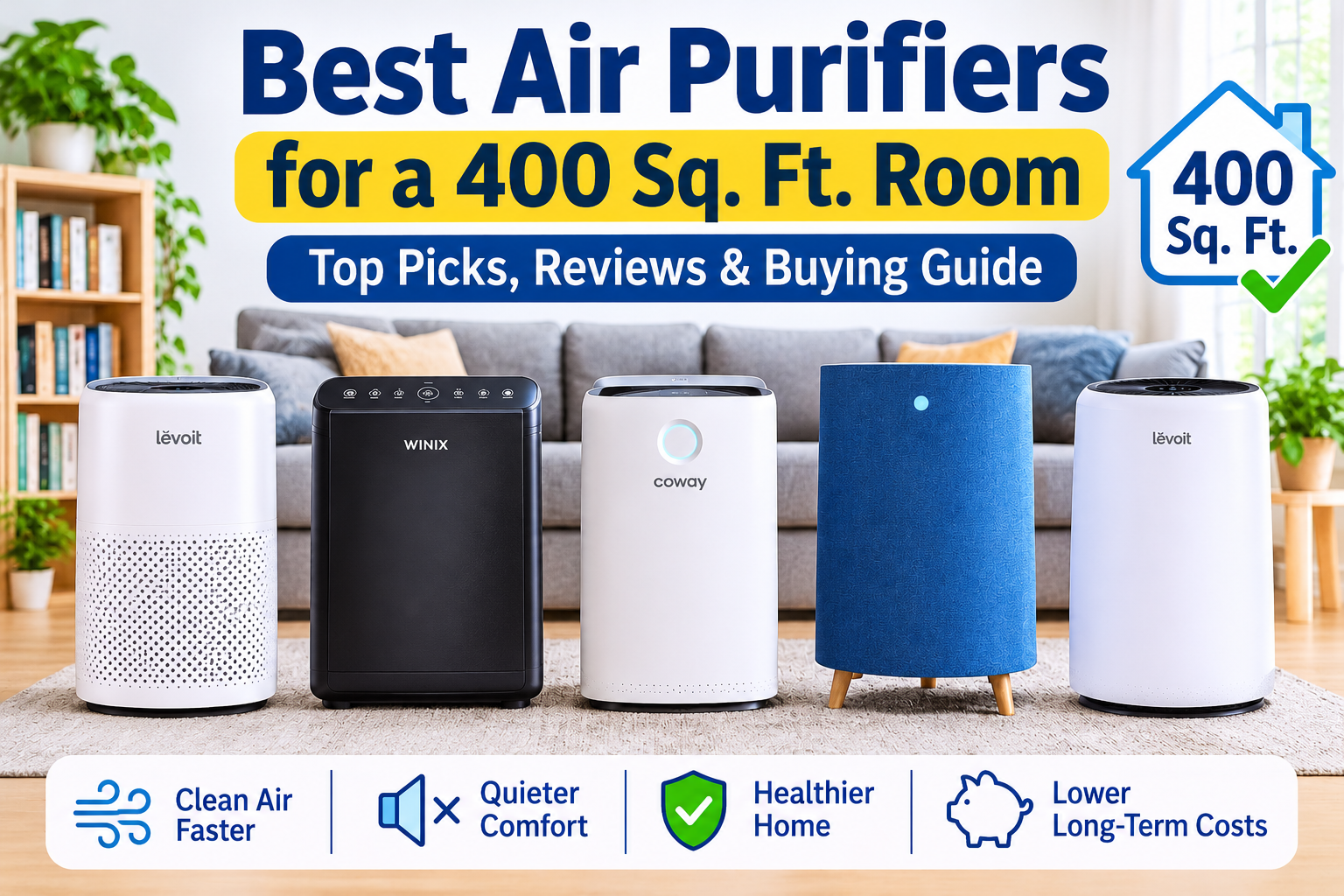
A practical buying guide to CADR, room coverage, noise levels, HEPA filtration, energy use, and replacement filter costs.
Target Audience: US Homeowners and Renters
Last Research Review: November 3, 2026
Introduction
Choosing an air purifier for a 400-square-foot room involves more than checking the coverage area printed on the product box. Two air purifiers may both claim to cover a room of this size, yet deliver very different results depending on their Clean Air Delivery Rate (CADR), fan speed, noise level, filter design, and operating conditions.
For a room this size, the goal is to find a purifier that can deliver enough clean air at a fan speed you can comfortably use every day. A unit that reaches its advertised performance only at maximum speed may be less practical for a bedroom or home office than a quieter model with adequate airflow.
This guide compares five air purifiers from Blueair, Levoit, Coway, and Winix. It examines manufacturer specifications alongside available independent testing, explains CADR and air changes per hour (ACH), and considers ongoing electricity and filter replacement costs.
Our central recommendation: Do not choose an air purifier for a 400-square-foot room based on advertised coverage alone. Compare its particle CADR, the ACH at which its coverage is rated, and its performance at noise levels you can tolerate.
Quick Comparison: Five Air Purifiers to Consider
| Model | Manufacturer Coverage / Rating | Key Performance Information | Best Suited To |
|---|---|---|---|
| Blueair Blue Signature Large | 705 sq. ft. at 4.8 ACH | 455 CFM smoke CADR; independent low-noise recommendation 332 sq. ft. | High-capacity performance |
| Levoit Core 600S-P | 606 sq. ft. at 4.8 ACH | 391 CFM advertised CADR | Smart features and capacity |
| Coway Airmega 400 | 1,560 sq. ft. at 2 ACH | 328 CFM smoke CADR | Mechanical filtration preference |
| Winix 5530 | 392 sq. ft. AHAM room rating | Independent maximum-speed recommendation 404 sq. ft.; low-noise 190 sq. ft. | Near-target room sizing |
| Winix C909 | 522 sq. ft. at 4.8 ACH | Independent maximum-speed recommendation 459 sq. ft.; low-noise 310 sq. ft. | Stronger performance at lower noise |
Manufacturer coverage figures and independent test-room recommendations use different methodologies. They should not be compared as if they were identical measurements.
1. Blueair Blue Signature Large — Best High-Capacity Candidate
The Blueair Blue Signature Large is a premium option for buyers who want substantial airflow and a design that can blend into a living room or open-plan space.
Key Specifications
| Specification | Published Information |
|---|---|
| Recommended room size | 705 sq. ft. |
| Stated air changes | 4.8 ACH |
| Smoke CADR | 455 CFM |
| Dust CADR | 434 CFM |
| Pollen CADR | 450 CFM |
| Noise range | 23–55 dB |
| Power consumption | 3.5–42 W |
| Filter life | Up to 1 year |
Blueair’s published specifications give the unit a 705-square-foot room rating at 4.8 ACH. Its 455 CFM smoke CADR is substantially above the approximately 267 CFM general AHAM sizing guideline for a 400-square-foot room.
What Independent Testing Says
RTINGS measured a PM1.0 CADR of 429 CFM and recommended the unit for rooms up to 670 sq. ft. at maximum fan speed. Its low-noise recommendation was 332 sq. ft., with a measured PM1.0 CADR of 213 CFM at the tested quieter setting.
That difference matters. The purifier has enough maximum-speed capacity for a 400-square-foot room, but its measured low-noise recommendation is smaller than the target room. Buyers who need strong overnight filtration should consider this trade-off rather than relying only on the 705-square-foot marketing figure.
Filtration and Maintenance
Blueair uses its HEPASilent filtration technology, which combines mechanical filtration with an ionization component. Buyers who specifically want a purely mechanical filtration system may prefer to compare the Coway Airmega 400.
The official replacement filter is listed at approximately $99.99, and Blueair states that filter life can reach one year depending on usage and air conditions.
Pros
- High manufacturer-rated smoke, dust, and pollen CADR.
- Strong maximum-speed independent particle performance.
- Useful capacity for larger rooms.
- Filter-life monitoring and a long stated replacement interval.
Cons
- Premium purchase price.
- Low-noise independent room recommendation is below 400 sq. ft.
- Ionization cannot be switched off independently.
Who should consider it? Buyers prioritizing high airflow for a living room or large shared space, and who are comfortable with its filtration technology and premium replacement-filter costs.
2. Levoit Core 600S-P — Best Smart-Feature Candidate
The Levoit Core 600S-P is a high-capacity purifier with app control, voice-assistant compatibility, and a manufacturer-rated coverage area that exceeds 400 sq. ft.
Key Specifications
| Specification | Published Information |
|---|---|
| Model | LAP-C601S-WUS |
| Recommended room size | 606 sq. ft. |
| Stated air changes | 4.8 ACH |
| Advertised CADR | 391 CFM |
| Noise range | 26–55 dB |
| Rated power | 49 W |
| Filtration | 3-stage |
| Filter replacement | Approximately 6–12 months |
Levoit’s official specifications list 606 sq. ft. at 4.8 ACH, a 391 CFM CADR, 49 W rated power, and a 26–55 dB noise range.
Smart Features
The Core 600S-P supports app-based control, air-quality monitoring, filter-life notifications, and voice control through Amazon Alexa and Google Assistant. It also includes sleep mode and automatic fan adjustment.
These features can make daily operation more convenient, particularly for someone who wants to monitor the purifier without repeatedly adjusting it manually.
What About Independent Testing?
RTINGS has published testing for the Core 600S, including a maximum-speed room recommendation of 567 sq. ft. and a low-noise recommendation of 253 sq. ft. However, the exact tested model is listed as Core 600S, not Core 600S-P.
Those measurements are useful background for understanding the product family, but they should not be presented as verified Core 600S-P test results without confirmation that the tested hardware and filtration configuration are equivalent.
Replacement Filters
Levoit’s official store lists the standard replacement filter at approximately $59.99, with other specialized replacement filter options priced higher. The appropriate replacement interval depends on operating conditions and filter type.
Pros
- High advertised CADR.
- Manufacturer-rated coverage above 400 sq. ft.
- App and voice-assistant control.
- Automatic mode and filter-life notifications.
Cons
- Exact-model independent test evidence needs careful verification.
- Replacement costs vary by filter type.
- Maximum-speed noise may not suit every bedroom.
Who should consider it? Buyers who value smart-home controls and want a high-capacity purifier with a manufacturer rating suitable for a 400-square-foot room.
3. Coway Airmega 400 — Best Option for Mechanical Filtration Preference
The Coway Airmega 400 is a large-format purifier with a washable pre-filter and a Max2 filter system that combines particle filtration with activated carbon.
It is worth considering if you prefer a conventional filter-based design rather than a purifier that relies on an ionization feature.
Key Specifications
| Specification | Published Information |
|---|---|
| Manufacturer coverage | 1,560 sq. ft. at 2 ACH |
| Smoke CADR | 328 CFM |
| Dust CADR | 328 CFM |
| Pollen CADR | 400 CFM |
| Noise range | 22–52 dB(A) |
| Power consumption | 66 W |
| Filter system | Washable pre-filter + Max2 |
| Max2 filter life | Up to 6–12 months |
Coway also lists 3,120 sq. ft. at 1 ACH. That figure should not be confused with coverage at the more demanding 4.8 ACH rate.
What Makes Its Filtration Different?
The Airmega 400 uses two Max2 filter assemblies, each combining HEPA filtration and activated carbon. Its washable pre-filters help capture larger particles before they reach the main filters.
This is useful for buyers who want particle filtration plus some reduction of common household odors. As with other carbon-based filters, performance against gases depends on the quantity and type of adsorbent material.
Is It Suitable for 400 Sq. Ft.?
Its published smoke CADR of 328 CFM is above the approximately 267 CFM general AHAM sizing guideline for a 400-square-foot room. That makes it a credible capacity candidate, although its manufacturer coverage figure of 1,560 sq. ft. is specified at only 2 ACH.
The Airmega 400 is not Wi-Fi or app-enabled. Buyers who want remote controls should compare the 400S separately rather than assuming the two models have identical connectivity.
Pros
- Strong published smoke CADR.
- Washable pre-filters.
- Combined HEPA and activated-carbon filtration.
- No ionization feature is listed in its filter-based design.
- Automatic, sleep, and eco operating modes.
Cons
- Large and relatively heavy.
- No app or Wi-Fi connectivity on the standard Airmega 400.
- Replacement filter costs should be checked before purchase.
- Manufacturer’s large-room coverage is stated at 2 ACH, not 4.8 ACH.
Who should consider it? Buyers who prioritize a large-capacity purifier with conventional mechanical particle filtration and activated carbon, rather than app connectivity or ionization technology.
4. Winix 5530 — Best Near-Target Room-Size Candidate
The Winix 5530 is an interesting choice because its AHAM room-size rating is close to 400 sq. ft. It also has independent testing that shows why maximum-speed and quieter-speed performance should be evaluated separately.
Key Specifications
| Specification | Published Information |
|---|---|
| AHAM room-size rating | 392 sq. ft. |
| Smoke CADR | 253 CFM |
| Dust CADR | 252 CFM |
| Pollen CADR | 247 CFM |
| Filtration | Pre-filter, carbon, True HEPA |
| Connectivity | Wi-Fi |
| Ionization feature | PlasmaWave; can be switched off |
The published AHAM figures put its smoke CADR slightly below the approximately 267 CFM general 2/3 guideline for a 400-square-foot room. That does not mean it cannot be used in a 400-square-foot room; it means buyers should understand the trade-off in cleaning rate.
Independent Performance
RTINGS measured a PM1.0 CADR of 258 CFM and recommended a maximum-speed room size of 404 sq. ft. At a quieter setting, its measured PM1.0 CADR was 122 CFM, with a room recommendation of 190 sq. ft.
Its measured noise ranged from 32.4 dBA at the lowest fan speed to 60.7 dBA at the highest.
The result is a clear use-case distinction: it can reach the target room size at maximum speed under RTINGS’ methodology, but it is not independently recommended for a full 400 sq. ft. room at its quieter test setting.
PlasmaWave and Filter Maintenance
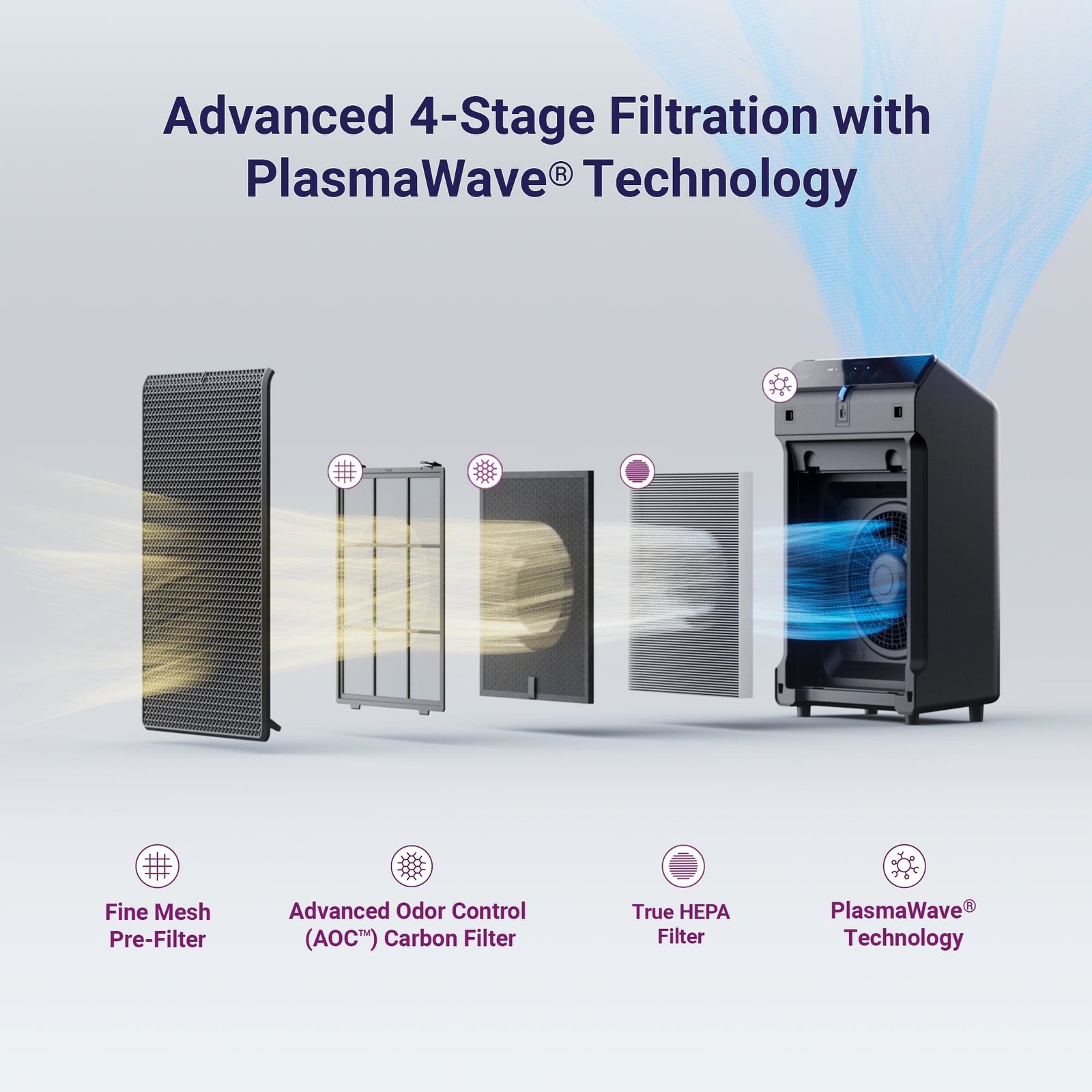
Winix’s PlasmaWave feature can be switched off. Buyers who prefer to avoid optional ionization can leave the feature off.
Pros
- Independent maximum-speed recommendation close to 400 sq. ft.
- Wi-Fi and automatic operation.
- True HEPA and activated-carbon filtration.
- PlasmaWave can be disabled.
Cons
- AHAM smoke CADR is below the general 267 CFM guideline.
- Low-noise independent room recommendation is only 190 sq. ft.
- Maximum-speed noise is relatively high.
Who should consider it? Buyers with a room close to 400 sq. ft. who want a connected purifier and are comfortable using higher fan speeds when stronger cleaning is needed.
5. Winix C909 — Best Low-Noise Performance Candidate Among These Winix Models
The Winix C909 is a larger-capacity model with Wi-Fi, a washable pre-filter, True HEPA filtration, activated carbon, and switchable PlasmaWave technology.
Key Specifications
| Specification | Published Information |
|---|---|
| AHAM room-size rating | 522 sq. ft. |
| Stated air changes | 4.8 ACH |
| Smoke CADR | 323 CFM |
| Dust CADR | 336 CFM |
| Pollen CADR | 384 CFM |
| Minimum noise | 26.2 dB |
| HEPA filter life | Up to 12 months |
| Warranty | 2 years |
Winix lists 522 sq. ft. as its AHAM-verified room size at 4.8 ACH. Its product information also describes Wi-Fi control, automatic operation, and a washable pre-filter.
Independent Performance
RTINGS measured a PM1.0 CADR of 294 CFM, with a maximum-speed room recommendation of 459 sq. ft. At a quieter setting, the measured PM1.0 CADR was 198 CFM, with a room recommendation of 310 sq. ft.
The measured noise range was 33.1–53.9 dBA. Compared with the Winix 5530, the C909 maintained stronger low-noise particle performance in RTINGS’ tests.
Maintenance
Winix states that the C909 includes one year of filtration in the box. Its official page lists a True HEPA filter life of 12 months and activated-carbon filter life of three months. Replacement costs should be checked for the specific filter pack before purchase.
Pros
- AHAM room-size rating above 400 sq. ft.
- Strong smoke CADR.
- Better low-noise test-room recommendation than the Winix 5530.
- Wi-Fi and automatic fan adjustment.
- PlasmaWave can be switched off.
Cons
- Low-noise test recommendation is still below 400 sq. ft.
- Replacement carbon filters require more frequent changes.
- Costco-exclusive availability may limit purchasing options.
Who should consider it? Buyers who want a larger-capacity Winix purifier and value better measured low-noise performance than the 5530, while accepting that quieter operation may still reduce its effective room coverage.
6. What Size Air Purifier Do You Need for a 400 Sq. Ft. Room?
Before choosing a model, understand two important measurements: Clean Air Delivery Rate (CADR) and Air Changes per Hour (ACH).
What Is CADR?
CADR measures how much filtered air an air purifier delivers, usually expressed in cubic feet per minute (CFM). AHAM provides separate CADR ratings for smoke, dust, and pollen.
A higher CADR generally means faster particle removal. For room sizing, the smoke CADR is commonly used because it represents the smallest of the three particle categories in the AHAM rating system.
What CADR Is Required for 400 Square Feet?
AHAM’s general 2/3 rule recommends a smoke CADR of at least two-thirds of the room’s floor area.
For a 400-square-foot room:
400 × 2/3 = 266.7
That means approximately 267 CFM of smoke CADR is a useful general target under the AHAM guideline.
ENERGY STAR’s separate room-sizing table lists a minimum estimated CADR of 260 CFM for 400 sq. ft., assuming an 8-foot ceiling. These two recommendations are close, but they are not identical.
How Many Air Changes per Hour Should You Choose?
ACH describes how many times an air purifier can process an amount of air equivalent to the room’s total volume in one hour.
For a 400 sq. ft. room with an 8-foot ceiling:
400 × 8 = 3,200 cubic feet
The simplified CADR calculation is:
CADR = (Room Volume × ACH) / 60
| Target ACH | Required CADR |
|---|---|
| 2 ACH | 107 CFM |
| 3 ACH | 160 CFM |
| 4 ACH | 213 CFM |
| 4.8 ACH | 256 CFM |
| 5 ACH | 267 CFM |
| 6 ACH | 320 CFM |
These calculations help explain why a purifier rated for 400 sq. ft. at one ACH may not be suitable for someone who wants substantially more frequent air cleaning.
Why Ceiling Height Matters
Floor area alone does not tell you how much air is inside a room. A room with a 10-foot ceiling contains more air than a room of the same floor area with an 8-foot ceiling.
| Ceiling Height | Room Volume | CADR for 4.8 ACH |
|---|---|---|
| 8 ft | 3,200 cu. ft. | 256 CFM |
| 9 ft | 3,600 cu. ft. | 288 CFM |
| 10 ft | 4,000 cu. ft. | 320 CFM |
If your room has high ceilings, use the room volume rather than relying only on the square-foot coverage figure.
What About Wildfire Smoke?
For general room sizing, AHAM recommends smoke CADR equal to at least two-thirds of the room area. For wildfire smoke, AHAM recommends smoke CADR equal to the room area.
For a 400-square-foot room, that means considering a smoke CADR closer to 400 CFM when wildfire smoke is a major concern. This is a more demanding recommendation than the general 267 CFM guideline.
7. Maximum-Speed Performance vs. Quiet Operation
One of the most important buying mistakes is assuming that an air purifier will deliver its highest CADR while operating quietly.
In practice, fan speed affects airflow. A purifier running at maximum speed may deliver substantially more clean air than the same machine running in sleep mode or at a low setting.
The independent results below illustrate the difference:
| Model | Maximum-Speed Room Recommendation | Low-Noise Room Recommendation |
|---|---|---|
| Blueair Blue Signature Large | 670 sq. ft. | 332 sq. ft. |
| Winix 5530 | 404 sq. ft. | 190 sq. ft. |
| Winix C909 | 459 sq. ft. | 310 sq. ft. |
| Levoit Core 600S | 567 sq. ft. | 253 sq. ft. |
The Levoit figures are for the tested Core 600S, not confirmed Core 600S-P measurements.
What Does This Mean for a Bedroom?
If you plan to run your purifier overnight, prioritize its performance at a noise level you can tolerate.
A purifier that is powerful enough at maximum speed but too loud to use consistently may not be the most practical choice.
For a 400-square-foot bedroom, compare:
- Independent low-noise CADR or room recommendation.
- Noise measurements at the tested fan setting.
- Whether display lights can be dimmed or switched off.
- Whether sleep mode reduces airflow substantially.
- Whether automatic mode changes fan speed frequently.
What Does This Mean for a Living Room?
A living room often has more background noise than a bedroom. You may be comfortable using a higher fan setting while watching television, cooking, or spending time with family.
For this situation, maximum-speed CADR and the ability to maintain airflow during everyday use may matter more than the lowest possible noise rating.
8. HEPA Filtration, Activated Carbon, and Indoor Air Quality
An air purifier’s filter system determines which pollutants it can capture or reduce. A product with a high CADR is not automatically effective against every type of indoor pollution.
What Does a HEPA Filter Capture?
High-efficiency particle filters are designed to capture airborne particles. Depending on the filter design and the purifier’s overall performance, these may include:
- Dust and fine particles.
- Pollen.
- Pet dander.
- Some mold spores.
- Smoke particles.
- Other airborne particulate matter.
When comparing products, look at the complete filtration system rather than relying on a single marketing term.
What Does Activated Carbon Do?
Activated carbon is used to adsorb certain gases and odors. It can be helpful for some cooking smells, household odors, and volatile organic compounds (VOCs).
However, the amount of carbon matters. EPA explains that gas removal depends on the quantity of adsorbent material, and CADR ratings are designed for particles rather than gases. A particle CADR should not be interpreted as a measurement of VOC removal.
Air Purifiers and Wildfire Smoke
Wildfire smoke contains fine particles and gases. A particle filter with sufficient smoke CADR can help reduce airborne particles indoors, while an appropriate gas-removal filter may help with some smoke-related gases and odors.
For wildfire smoke:
- Choose a purifier with a sufficiently high smoke CADR.
- Use a properly sized particle filter.
- Keep windows and doors closed when outdoor smoke is high, where practical.
- Follow local public-health guidance.
- Replace overloaded filters according to manufacturer instructions.
EPA recommends choosing a portable air cleaner with a smoke CADR at least two-thirds of the room area and considering higher capacity for greater particle removal.
What About Ionizers and Ozone?
Some air purifiers use ionization, plasma, or electrostatic technologies in addition to mechanical filtration.
Ozone is a lung irritant. EPA advises avoiding air cleaners that intentionally generate ozone. California’s Air Resources Board requires applicable indoor air-cleaning devices sold in California to meet an ozone-emission limit of 0.050 ppm, or 50 parts per billion. CARB certification is not, by itself, proof of particle-removal performance.
For buyers who prefer mechanical filtration, it is sensible to check whether a purifier includes optional ionization and whether that feature can be disabled.
9. Electricity and Replacement Filter Costs
The initial purchase price is only one part of owning an air purifier. You should also consider electricity use, replacement filters, and maintenance.
How Much Electricity Does an Air Purifier Use?
A purifier’s electricity consumption depends on its wattage, fan speed, and operating hours.
Use this formula to estimate annual energy consumption:
kWh/year = (Watts × Hours/day × 365) / 1,000
For example, a purifier rated at 49 watts, running continuously for 24 hours each day, would use:
(49 × 24 × 365) / 1,000 = 429.24 kWh/year
At an electricity rate of $0.17 per kWh, the illustrative annual cost would be approximately $73.
This is a calculation based on continuous operation at the stated wattage, not a measured annual bill. Actual consumption varies with fan speed, auto mode, and operating conditions.
Replacement Filter Costs
| Model | Published Filter Information |
|---|---|
| Blueair Blue Signature Large | Approximately $99.99 for the replacement filter |
| Levoit Core 600S-P | Approximately $59.99 for the standard filter |
| Coway Airmega 400 | Check the genuine Max2 replacement set for current pricing |
| Winix 5530 | Check the exact compatible HEPA and carbon filter pack |
| Winix C909 | Check the exact compatible filter pack and replacement schedule |
Prices are snapshots and can change. Verify current US prices and compatible filter part numbers before purchasing.
How to Compare Three-Year Ownership Costs
Use this calculation:
Three-year cost = Purchase price + Electricity cost + Replacement filters + Other maintenance
For a fair comparison, use the same electricity rate and operating schedule for every model. Include the number of filter replacements actually required over three years, rather than assuming every filter lasts exactly one year.
A purifier with a lower purchase price may become more expensive over time if it requires frequent or costly replacement filters.
10. Which Air Purifier Is Best for Your Situation?
The best model depends on how you use the room and what you want the purifier to do.
| Your Priority | Model to Investigate | Reason |
|---|---|---|
| High maximum-speed capacity | Blueair Blue Signature Large | Strong published CADR and independent maximum-speed performance |
| Smart-home features | Levoit Core 600S-P | App, voice control, and automatic operation |
| Mechanical filtration preference | Coway Airmega 400 | Washable pre-filter and Max2 HEPA/carbon system |
| Room coverage close to 400 sq. ft. | Winix 5530 | Independent maximum-speed recommendation of 404 sq. ft. |
| Stronger low-noise performance among the two Winix models | Winix C909 | Higher independent low-noise room recommendation than the 5530 |
For a 400-Square-Foot Bedroom
Start by comparing low-noise performance. Do not select a purifier solely because its maximum-speed rating covers 400 sq. ft.
For a Living Room
Consider the room’s ceiling height, open doorways, connected spaces, and background noise. A higher-capacity purifier may be useful if you can comfortably operate it at a higher fan speed.
For Pets and Allergies
Prioritize particle filtration, sufficient CADR, a washable pre-filter where available, and easy filter replacement. Remember that an air purifier does not remove allergens that have settled on furniture, carpets, and bedding.
For Wildfire Smoke
Prioritize a high smoke CADR and suitable particle filtration. A smoke CADR near 400 CFM is a more demanding target for a 400-square-foot room under AHAM’s wildfire-smoke recommendation.
For Open-Plan Spaces
A single purifier may not provide uniform cleaning across multiple connected rooms. Airflow obstructions, doorways, walls, and the distance between the purifier and the pollutant source all matter. You may need multiple units or a larger-capacity solution.
11. Frequently Asked Questions
1. What size air purifier do I need for a 400 sq. ft. room?
For an 8-foot ceiling, ENERGY STAR’s estimated minimum CADR is 260 CFM. AHAM’s general 2/3 rule suggests a smoke CADR of approximately 267 CFM. Consider a higher rating if you want more frequent air cleaning or need additional capacity for wildfire smoke.
2. Is 250 CFM enough for a 400-square-foot room?
A 250 CFM CADR is close to the general sizing recommendations, but slightly below the approximately 267 CFM AHAM 2/3 guideline. It may still be useful, depending on the room, ceiling height, and desired cleaning rate.
3. Is 300 CFM good for a 400 sq. ft. room?
Yes. A 300 CFM particle CADR is above the general 267 CFM guideline. It provides additional capacity, although actual performance depends on the purifier’s operating speed and the room’s conditions.
4. How many ACH should an air purifier provide?
For a 400-square-foot room with an 8-foot ceiling, approximately 4.8 ACH requires 256 CFM under the simplified room-volume calculation. Higher ACH requires proportionally more airflow. Choose the target based on your indoor-air concerns, room conditions, and noise tolerance.
5. Can one air purifier clean an open-plan living room?
It depends on the total connected area, ceiling height, and airflow between spaces. A purifier’s advertised room coverage does not guarantee uniform cleaning throughout multiple connected rooms. Consider a higher-capacity unit or multiple purifiers when necessary.
6. Is a HEPA air purifier better than an activated-carbon purifier?
They address different pollutant categories. HEPA-type particle filtration captures airborne particles, while activated carbon is used to adsorb certain gases and odors. For broader filtration, many purifiers combine both technologies.
7. Are air purifiers effective against wildfire smoke?
A properly sized particle air cleaner can reduce airborne smoke particles indoors. Choose a purifier with a sufficiently high smoke CADR, use it consistently, and follow public-health guidance during smoke events. Activated carbon may help with some gases and odors, but performance varies with the amount of carbon.
8. Should I run my air purifier all day?
Continuous operation can provide more consistent particle filtration, provided the unit is maintained and operated according to its instructions. Higher fan speeds and longer run times generally increase the amount of air filtered.
9. How often should I replace an air purifier filter?
Follow the manufacturer’s recommended replacement schedule. Filter life depends on usage, pollution levels, and filter design. Some filters last around a year, while certain carbon filters require more frequent replacement.
10. Are ionizing air purifiers safe?
Ionizing technologies vary. Ozone is a lung irritant, so EPA advises avoiding devices that intentionally generate ozone. If a purifier has an optional ionization feature, check its emissions information and whether the feature can be switched off.
12. Final Verdict: Which Air Purifier Should You Choose for 400 Sq. Ft.?
There is no single best air purifier for every 400-square-foot room. Your choice should depend on whether you prioritize maximum particle removal, quiet operation, smart features, conventional mechanical filtration, or long-term maintenance costs.
Here is how the five candidates compare:
- Blueair Blue Signature Large: A strong high-capacity candidate for living rooms and larger shared spaces. Its independent low-noise room recommendation is smaller than 400 sq. ft., so consider your intended fan speed.
- Levoit Core 600S-P: A compelling option if you value smart controls and high manufacturer-rated capacity. Confirm exact-model independent performance before comparing it directly with tested alternatives.
- Coway Airmega 400: Worth considering if you prefer a conventional HEPA and activated-carbon filter system with a strong published smoke CADR.
- Winix 5530: Its maximum-speed independent room recommendation is close to 400 sq. ft., but its quieter-speed recommendation is substantially smaller.
- Winix C909: Offers stronger low-noise independent performance than the 5530 in the cited testing, although its low-noise recommendation remains below 400 sq. ft.
Our buying advice: For a 400-square-foot room, begin with a smoke CADR around 267 CFM or higher, adjust for ceiling height, and compare independent low-noise performance before making your final decision. If wildfire smoke is a major concern, consider a smoke CADR closer to 400 CFM.
A well-sized purifier that you can operate consistently is generally a more practical choice than a powerful model that is too noisy to use at the settings you need.
Sources and References
- US EPA — Guide to Air Cleaners in the Home: https://www.epa.gov/indoor-air-quality-iaq/air-cleaners-and-air-filters-home
- ENERGY STAR — Air Cleaners: https://www.energystar.gov/products/air_cleaners
- AHAM Verifide — Air Filtration Standards: https://ahamverifide.org/
- US EPA — Indoor Air Filtration: https://www.epa.gov/indoor-air-quality-iaq
- California Air Resources Board — Ozone Emissions Regulation: https://ww2.arb.ca.gov/
- Blueair — Blue Signature: https://www.blueair.com/products/blue-signature
- Levoit — Core 600S-P: https://levoit.com/collections/air-purifiers/products/core-600s-p-smart-air-purifier
- Coway — Airmega 400: https://cowaymega.com/collections/air/products/airmega-400
- Winix — 5530: https://www.winixamerica.com/product/5530/
- Winix — C909: https://www.winixamerica.com/product/c909/
- RTINGS — Independent Air Purifier Reviews: https://www.rtings.com/air-purifier
Editorial and Affiliate Disclosure
Product specifications and prices can change. Readers should verify current pricing, replacement-filter compatibility, warranty terms, and availability on the manufacturer’s website before purchasing.
Independent test measurements are identified separately from manufacturer claims. Where exact-model independent testing was not verified, this guide does not present another model’s results as equivalent evidence.
If affiliate links are used on BestAirPurifierOnline.com, the website should clearly disclose that it may earn a commission from qualifying purchases, without additional cost to the reader.