
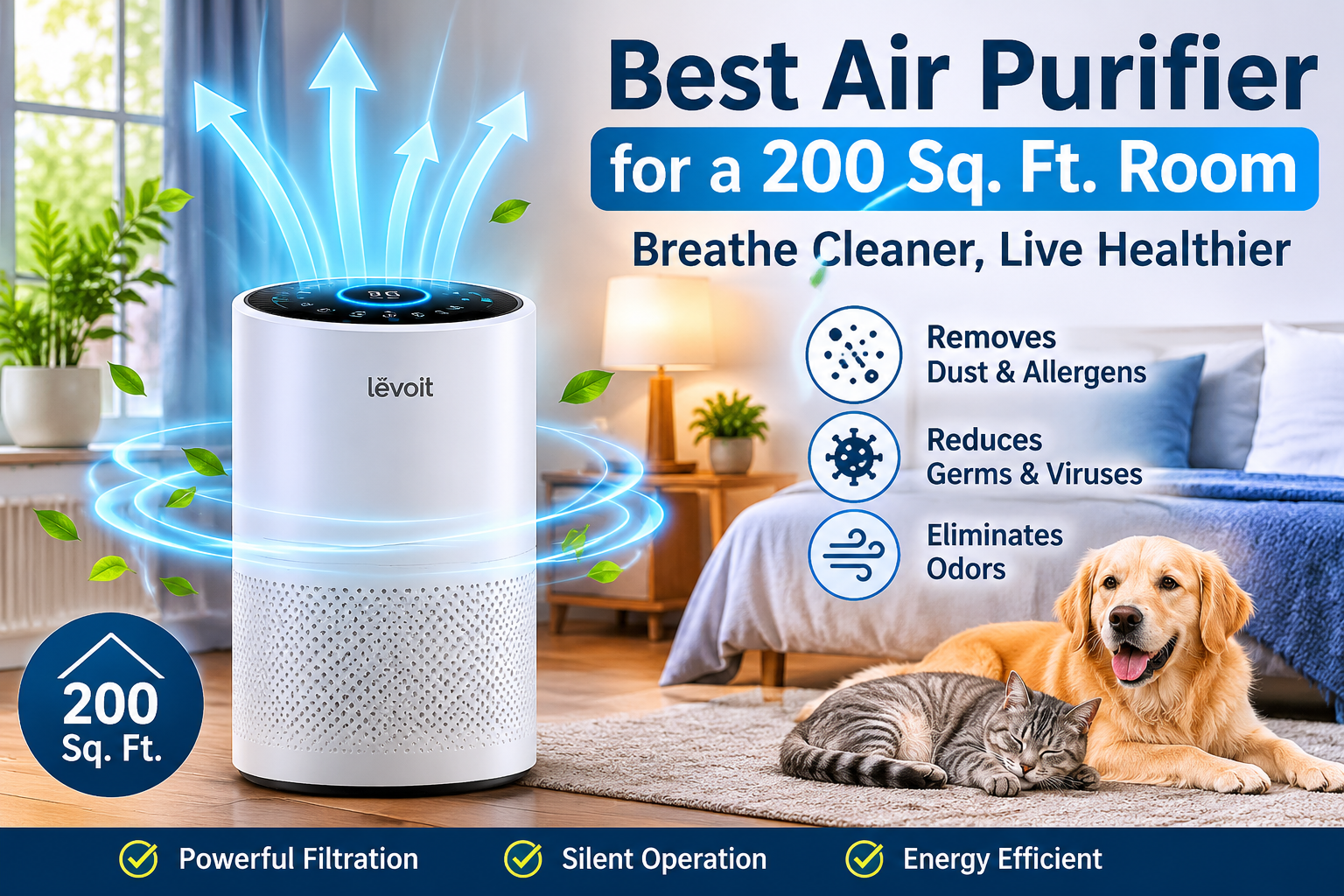
Choosing the best air purifier for a 200-square-foot room involves more than checking the maximum room size printed on the product box. You also need to consider Clean Air Delivery Rate (CADR), filtration technology, operating noise, replacement filter expenses, and how long the unit will run each day.
A 200-square-foot bedroom, home office, nursery, or studio room is generally manageable with a properly sized portable air purifier. However, choosing a model with insufficient airflow may force you to operate it at higher fan speeds to achieve the level of particle removal you want.
For most standard rooms with 8-foot ceilings, a useful starting point is an air purifier with a smoke CADR of approximately 130 CFM or higher. If you are concerned about wildfire smoke, AHAM recommends a smoke CADR at least equal to the room’s floor area.
In this guide, we compare five air purifiers, explain the difference between CADR and room coverage, discuss noise and filter maintenance, and show you how to estimate ongoing ownership costs.
Quick Answer: The Levoit Core 300 is a practical compact option for a standard 200-square-foot room. The Coway Airmega 150 offers a convenient filter design and automatic operation. The Blueair Blue Pure 311i Max provides substantially more airflow headroom, while the Winix A230 is another compact option worth considering.
Quick Buying Recommendations
| Air Purifier | Best For | Main Advantage |
|---|---|---|
| Levoit Core 300 | Overall value | Compact design and 143 CFM smoke CADR |
| Coway Airmega 150 | Bedrooms and everyday allergens | Automatic operation and easy filter access |
| Blueair Blue Pure 311i Max | Higher airflow capacity | 283 CFM smoke CADR |
| Winix A230 | Compact budget option | AHAM-verified room coverage and automatic mode |
| Winix 5500-2 | Carbon filtration and odor concerns | Washable granular carbon filter |
Product specifications and availability can change. Check the exact U.S. model and current manufacturer information before purchasing.
How We Evaluate Air Purifiers for a 200 Sq. Ft. Room
A useful air purifier comparison should consider more than marketing claims. The following criteria help determine whether a model is suitable for a particular room.
- Smoke CADR: Helps evaluate particle-cleaning capacity, particularly for smaller airborne particles.
- AHAM room coverage: Indicates the room size associated with a standardized air-cleaning performance rating.
- Noise level: Important when the purifier will operate in a bedroom, nursery, or office.
- Filtration system: Determines whether the unit primarily addresses particles, odors, or both.
- Replacement filters: Recurring costs can affect the long-term value of a purifier.
- Energy consumption: Depends on power draw, fan speed, and operating hours.
- Maintenance: Accessible pre-filters and clear replacement indicators can make routine care easier.
We distinguish manufacturer-published specifications from independent testing wherever possible. A published CADR rating should not be confused with performance at every fan speed.
Understanding CADR: What Does a 200 Sq. Ft. Room Need?
Clean Air Delivery Rate, commonly called CADR, measures how much filtered air an air purifier delivers. It is expressed in cubic feet per minute (CFM).
CADR ratings commonly include three particle categories:
- Smoke: Represents smaller airborne particles.
- Dust: Represents medium-sized particles.
- Pollen: Represents larger airborne particles.
Higher CADR values generally mean that an air purifier can deliver clean air more quickly. For a room where fine particles are the primary concern, smoke CADR is a particularly useful comparison metric.
The AHAM 2/3 Sizing Rule
The Association of Home Appliance Manufacturers (AHAM) provides a useful sizing guideline: an air purifier’s smoke CADR should be at least two-thirds of the room’s floor area.
For a 200-square-foot room:
Minimum smoke CADR = 200 × 2/3
Minimum smoke CADR ≈ 133 CFM
For practical shopping purposes, approximately 130–135 CFM is a reasonable starting point for a standard room with an 8-foot ceiling.
This is a general sizing guideline, not a guarantee that every room will have identical air quality. Higher ceilings, open floor plans, pollutant sources, and room layout can affect the result.
For wildfire smoke, AHAM recommends a smoke CADR equal to the room’s floor area. That means a 200-square-foot room would call for approximately 200 CFM or more.
Source: AHAM Verifide, Air Filtration Standards
https://ahamverifide.org/ahams-air-filtration-standards/
What Is ACH and Why Does It Matter?
Air Changes per Hour (ACH) describes how many equivalent room volumes of air an air cleaner can process in one hour.
For a 200-square-foot room with an 8-foot ceiling:
- Room area: 200 sq. ft.
- Ceiling height: 8 ft.
- Room volume: 1,600 cubic feet.
The simplified calculation is:
ACH = (CADR × 60) ÷ Room Volume
For a purifier delivering 143 CFM:
ACH = (143 × 60) ÷ 1,600
ACH ≈ 5.36
This is a theoretical estimate using the stated CADR and room volume. Actual room performance depends on fan speed, air mixing, placement, room configuration, and pollutant sources.
AHAM’s suggested room-size ratings are based on a standardized air-cleaning approach. When comparing products, use the manufacturer’s or AHAM’s stated room coverage rather than assuming that every advertised square-foot figure represents the same ACH.
Why Buying a Higher-CADR Air Purifier Can Help
A purifier with a higher maximum CADR may provide more airflow capacity than a smaller model.
That additional capacity can be useful because you may be able to operate a larger unit at a lower fan setting while still delivering meaningful airflow.
However, there is an important limitation: manufacturers generally publish CADR at a specified test condition, commonly the highest fan speed. You should not assume that a unit rated at 250 CFM on high will deliver 130 CFM on low or medium.
If quiet operation is important, look for independent airflow measurements at lower fan speeds or choose a model whose published noise and airflow information fits your needs.
5 Best Air Purifiers for a 200 Sq. Ft. Room
1. Levoit Core 300 – Best Overall Value for a Compact Room
The Levoit Core 300 is a compact cylindrical air purifier designed for bedrooms, home offices, and other smaller living spaces.
Its current U.S. product specifications list a smoke CADR of 143 CFM and an ideal room size of 222 square feet at 4.8 air changes per hour. That makes it a reasonable match for a standard 200-square-foot room.
The unit uses a three-stage filtration system and offers a dedicated Sleep Mode. Its compact footprint also makes placement easier in rooms where floor space is limited.
Key Specifications
| Feature | Specification |
|---|---|
| Model | Levoit Core 300 |
| Ideal Room Size | 222 sq. ft. at 4.8 ACH |
| CADR | 143 CFM |
| Noise Level | 24–54.5 dB |
| Rated Power | 56W |
| Filtration | Three-stage filtration |
| Sleep Mode | Yes |
| Warranty | 2-year limited warranty |
Why Consider the Levoit Core 300?
- Compact cylindrical design.
- Smoke CADR above the approximate 130–135 CFM starting point for a 200-square-foot room.
- Sleep Mode for bedroom operation.
- Activated carbon filtration to help reduce household odors.
- Replacement filter options designed for different household needs.
Potential Limitations
- Its maximum airflow capacity is lower than that of larger models.
- The manufacturer lists 56W rated power, so actual electricity use will depend on the selected fan setting and operating time.
- It does not provide the same airflow headroom as larger high-CADR models.
Best For: Buyers who want a compact purifier for a standard bedroom or home office and do not need the higher airflow capacity of a larger unit.
Official product information:
https://levoit.com/products/core300-p-air-purifier
2. Coway Airmega 150 – Best for Everyday Bedroom Filtration
The Coway Airmega 150 is a compact air purifier with a three-stage filtration system consisting of a pre-filter, deodorization filter, and HEPA filter.
Its design focuses on convenient maintenance. The pre-filter can be accessed for cleaning, while the unit also includes automatic speed control based on detected particle levels.
Coway lists coverage of 214 square feet at 4.8 air changes per hour, making it closely matched to a 200-square-foot room.
Key Specifications
| Feature | Specification |
|---|---|
| Model | Coway Airmega 150 |
| Room Coverage | 214 sq. ft. at 4.8 ACH |
| Smoke CADR | 153 CFM |
| Dust CADR | 161 CFM |
| Pollen CADR | 220 CFM |
| Noise Level | 19.98–48.3 dB(A) |
| Power Consumption | 35W |
| Filtration | Pre-filter, deodorization filter, HEPA filter |
| Filter Life | Deodorization filter: approximately 6 months; HEPA filter: approximately 1 year |
Why Consider the Coway Airmega 150?
- Room coverage is closely matched to the target room size.
- Automatic operation adjusts fan speed based on detected particle levels.
- Easy-to-access pre-filter.
- Published smoke CADR exceeds the basic 200-square-foot sizing estimate.
- Compact design suitable for bedrooms and smaller living spaces.
Potential Limitations
- Its smoke CADR is lower than that of the Blueair 311i Max.
- Buyers should compare replacement filter prices and availability before purchasing.
- The unit’s maximum noise level may be noticeable at higher fan settings.
Best For: People who want a compact purifier with automatic operation and convenient filter maintenance for everyday bedroom use.
Official product information:
https://cowaymega.com/collections/air/products/airmega-150
3. Blueair Blue Pure 311i Max – Best for Higher Airflow Capacity
The Blueair Blue Pure 311i Max is a larger-capacity air purifier designed for medium-sized rooms, bedrooms, and home offices.
Its higher smoke CADR provides more airflow headroom than the compact models in this comparison. Blueair lists a recommended room size of 439 square feet at 4.8 ACH.
For a 200-square-foot room, that capacity may be useful for shoppers who want additional particle-cleaning capacity, especially when the room has higher pollutant loads.
The model uses Blueair’s HEPASilent technology, which combines mechanical filtration with electrostatic particle charging.
Key Specifications
| Feature | Specification |
|---|---|
| Model | Blue Pure 311i Max |
| Recommended Room Size | 439 sq. ft. |
| Smoke CADR | 283 CFM |
| Dust CADR | 314 CFM |
| Pollen CADR | 365 CFM |
| Noise Level | 23–50 dB |
| Energy Consumption | 32W |
| Filtration | HEPASilent technology |
| Filter Life | Up to 9 months, depending on use |
| Warranty | 1 year, extendable to 3 years with registration |
Why Consider the Blueair Blue Pure 311i Max?
- Higher smoke CADR than the other models in this comparison.
- Large recommended room coverage.
- Low published minimum noise rating.
- Smart controls and automatic operation.
- Replacement filter tracking through the Blueair system.
Potential Limitations
- It is physically larger than compact bedroom purifiers.
- Replacement filters can add to long-term ownership costs.
- The advertised CADR values should not be interpreted as the airflow delivered at every fan setting.
- The manufacturer lists multiple filter types, so buyers should check which filter is included and which replacement is appropriate.
Best For: Buyers who want higher airflow capacity and additional room-size flexibility rather than the smallest possible purifier.
Official product information:
https://www.blueair.com/collections/sleep-collection/products/blue-pure-311i-max
4. Winix A230 – Best Compact Budget Option
The Winix A230 is a compact air purifier with a four-stage filtration system that includes a pre-filter, True HEPA filter, activated carbon filter, and PlasmaWave technology.
Winix currently lists AHAM-verified coverage of 246 square feet at 4.8 air changes per hour.
Its smoke CADR is 147 CFM, which places it above the approximate 130–135 CFM starting point for a standard 200-square-foot room.
The model also includes a particle sensor and Auto Mode, allowing it to adjust operation based on detected air quality.
Key Specifications
| Feature | Specification |
|---|---|
| Model | Winix A230 |
| AHAM-Verified Room Size | 246 sq. ft. |
| Dust CADR | 149 CFM |
| Pollen CADR | 154 CFM |
| Smoke CADR | 147 CFM |
| Minimum Noise | 25 dB |
| Filtration | Four-stage filtration |
| HEPA Filter Life | Approximately 12 months |
| Carbon Filter Life | Approximately 12 months |
| Warranty | 2 years |
Why Consider the Winix A230?
- AHAM-verified room coverage.
- Smoke CADR suitable for a standard 200-square-foot room.
- Automatic fan-speed adjustment.
- Compact tower design.
- Replaceable HEPA and carbon filtration stages.
Potential Limitations
- Its smoke CADR is lower than that of larger models.
- PlasmaWave is an electronic air-cleaning feature; users who prefer mechanical filtration should review the operating instructions and available controls.
- Actual noise depends on the fan setting.
Best For: Buyers looking for a compact purifier with automatic operation and a room rating suitable for a medium-sized bedroom.
Official product information:
https://www.winixamerica.com/product/a230/
5. Winix 5500-2 – Best for Buyers Interested in Granular Carbon Filtration
The Winix 5500-2 is a larger air purifier known for its combination of a True HEPA filter and a washable Advanced Odor Control (AOC) carbon filter.
Unlike thin carbon-coated filter layers, its granular carbon filter is designed to help adsorb household odors. The EPA notes that activated carbon can be useful for gases and odors when a sufficient amount of adsorbent material is present.
The model also includes PlasmaWave technology, which can be switched off according to the product instructions.
Published product specifications list a verified room size of 360 square feet and a maximum power rating of 70W. Independent testing has also evaluated its particle-cleaning performance and noise.
Key Specifications
| Feature | Specification |
|---|---|
| Model | Winix 5500-2 |
| Verified Room Size | 360 sq. ft. |
| Smoke CADR | 232 CFM |
| Dust CADR | 243 CFM |
| Pollen CADR | 246 CFM |
| Power Rating | 70W |
| Filtration | Pre-filter, True HEPA, granular carbon |
| Additional Technology | PlasmaWave |
| Warranty | Check current seller and manufacturer terms |
Why Consider the Winix 5500-2?
- Granular activated carbon filter for household odor concerns.
- High published CADR ratings.
- Washable carbon filter.
- Automatic operation and particle sensing.
- Larger room coverage than required for a typical 200-square-foot bedroom.
Potential Limitations
- Larger cabinet than compact bedroom models.
- Higher maximum power rating than some smaller purifiers.
- Product availability may vary. Independent testing sources report that the model has been replaced by newer Winix products in some markets.
- Confirm replacement filter availability and warranty terms before purchasing.
Best For: Buyers who specifically want a purifier with a granular carbon filter and can confirm that the model and replacement filters are available.
Manufacturer manual:
https://www.winixamerica.com/wp-content/uploads/2022/07/User-Manual_5500-2.pdf
Independent review:
https://www.rtings.com/air-purifier/reviews/winix/5500-2
Air Purifier Comparison Table
The following table summarizes the published specifications used in this guide. Always check the exact model version before purchasing.
| Model | Best For | Room Coverage | Smoke CADR | Dust CADR | Pollen CADR | Noise |
|---|---|---|---|---|---|---|
| Levoit Core 300 | Compact value | 222 sq. ft. | 143 | 140* | 145* | 24–54.5 dB |
| Coway Airmega 150 | Bedroom use | 214 sq. ft. | 153 | 161 | 220 | 19.98–48.3 dB |
| Blueair 311i Max | Higher airflow | 439 sq. ft. | 283 | 314 | 365 | 23–50 dB |
| Winix A230 | Compact budget option | 246 sq. ft. | 147 | 149 | 154 | 25 dB minimum |
| Winix 5500-2 | Carbon filtration | 360 sq. ft. | 232 | 243 | 246 | Varies by test and setting |
Levoit Core 300 CADR figures shown for dust and pollen should be checked against the exact current model documentation before publication; the current U.S. manufacturer page confirms a CADR of 143 CFM.
Important: CADR is generally measured under specified test conditions, often at the highest fan speed. Noise ratings may use different measurement methods and operating conditions, so they should not be treated as perfectly comparable across brands.
What to Look for When Buying an Air Purifier for a Bedroom
1. Noise Levels and Sleep Comfort
Noise is an important consideration if the purifier will run overnight.
Air purifier manufacturers often publish a minimum and maximum sound rating. The minimum value usually corresponds to a low or sleep setting, while the maximum value is associated with higher fan speeds.
A lower published dB rating can be helpful for bedroom use, but the number alone does not tell you everything about the sound experience. Fan tone, airflow, room acoustics, and distance from the bed can also affect perceived noise.
Before purchasing, consider:
- Whether the model has a dedicated Sleep or Night Mode.
- Whether the display lights can be dimmed or switched off.
- Whether the lowest fan setting provides enough airflow for your needs.
- Whether independent testing is available at different fan speeds.
The EPA notes that noise ratings vary with fan speed and suggests considering a unit with a low published noise rating if sound might prevent you from operating it.
2. True HEPA and Other Particle Filters
HEPA filtration is designed to capture airborne particles.
The commonly cited U.S. Department of Energy HEPA definition specifies at least 99.97% efficiency for particles measuring 0.3 microns under the applicable test conditions.
A HEPA filter can help capture particles such as:
- Dust
- Pollen
- Pet dander
- Some mold spores
- Fine airborne particles
However, not every product that uses terms such as “HEPA-type” or “HEPA-like” meets the same performance standard.
Check the manufacturer’s exact filtration claims and product documentation rather than relying only on marketing language.
3. Activated Carbon for Odors and Gases
A particle filter and a gas filter perform different jobs.
HEPA filtration primarily addresses airborne particles. Activated carbon is used to adsorb certain gases and odors.
It may help with:
- Cooking odors
- Some pet odors
- Smoke-related odors
- Certain volatile organic compounds (VOCs)
The amount and type of carbon matter. The EPA explains that carbon filters can be effective for gases when they contain a sufficient quantity of adsorbent material.
A thin carbon-coated sheet should not automatically be considered equivalent to a substantial granular carbon filter.
Also remember that CADR ratings measure particle removal, not general VOC or gas removal performance.
4. Ionizers, PlasmaWave, and Ozone Considerations
Some air purifiers include electronic technologies such as ionizers, electrostatic particle charging, or plasma-based features.
These technologies should be evaluated separately from the unit’s mechanical filtration system.
The EPA advises consumers to avoid air cleaners that intentionally produce ozone because ozone is a lung irritant. Some electronic air-cleaning technologies may have the potential to emit ozone, depending on their design and operation.
California’s CARB regulation requires applicable indoor air-cleaning devices sold in California to meet an ozone-emission limit of 0.050 parts per million, subject to the regulation’s requirements and exemptions.
CARB certification is a regulatory ozone-emissions compliance measure. It does not mean that a device removes every pollutant or guarantees that every user will have the same indoor-air experience.
If you prefer a simpler filtration approach, consider a model that relies on mechanical filtration or allows optional electronic features to be switched off.
Official references:
- EPA: https://www.epa.gov/indoor-air-quality-iaq/guide-air-cleaners-home
- CARB: https://ww2.arb.ca.gov/resources/documents/indoor-air-cleaning-devices-regulation
How Much Does It Cost to Run an Air Purifier?
The electricity cost of an air purifier depends on its power consumption, fan setting, daily operating hours, and local electricity rate.
You can estimate electricity costs using this formula:
Electricity Cost = (Watts ÷ 1,000) × Hours Used × Electricity Rate
For example, assume an air purifier draws an average of 30 watts and operates for 12 hours per day. If electricity costs $0.16 per kWh:
30 ÷ 1,000 × 12 × $0.16 = $0.0576 per day.
Estimated monthly electricity cost:
$0.0576 × 30 = approximately $1.73 per month.
This is an illustrative calculation, not a measured cost for any specific model.
Why Maximum Wattage Is Not the Same as Average Electricity Use
A product’s maximum rated wattage does not necessarily represent the amount of electricity it uses throughout the day.
A purifier may consume less power on Sleep or Low mode than on its highest setting. Automatic operation may also change power consumption as the fan speed changes.
For a more accurate ownership estimate, look for:
- ENERGY STAR annual energy-use data, when available.
- Manufacturer power-consumption figures at individual fan speeds.
- Independent energy measurements.
- Your expected daily operating hours.
Don’t Forget Replacement Filter Costs
Replacement filters are another recurring expense.
Before purchasing, check:
- The price of genuine replacement filters.
- The recommended replacement interval.
- Whether the model uses one combined filter or multiple separate filters.
- Whether the pre-filter is washable or vacuum-cleanable.
- Whether replacement filters are readily available in the United States.
A low initial purchase price does not always mean the lowest long-term ownership cost.
How to Place an Air Purifier in a 200 Sq. Ft. Room
Correct placement helps prevent airflow restrictions and makes it easier for the purifier to circulate room air.
Follow these practical guidelines:
Keep the air intake clear. Avoid placing the purifier directly against curtains, furniture, or other objects that block its intake or outlet.
Follow the manufacturer’s clearance instructions. Different models have different intake and outlet designs. Use the clearance distances specified in the product manual.
Place it in the room where it is needed. If the main concern is bedroom air quality, operate the purifier in the bedroom rather than assuming a unit in another room will clean the entire home.
Avoid obstructing airflow. Do not cover the unit or place objects on its air outlet.
Consider room layout. Open doors, connected spaces, high ceilings, and large furniture can affect how air moves through the room.
Run the purifier consistently. Higher fan speeds and longer operating times generally increase the amount of air filtered. If noise is a concern, use a quieter setting that still provides suitable airflow.
Air Purifier Maintenance: What Should You Do?
Routine maintenance helps keep an air purifier operating as intended.
Clean the Pre-Filter
Many models include a washable or vacuum-cleanable pre-filter that collects larger particles such as hair, lint, and dust.
Follow the manufacturer’s cleaning instructions. Not every filter component can be washed.
Replace the Main Filter When Required
HEPA and carbon filters need replacement according to the manufacturer’s recommendations and actual usage conditions.
Replacement timing can depend on:
- Indoor pollution levels.
- Pet ownership.
- Smoke exposure.
- Daily operating hours.
- Fan speed.
- Filter condition.
Do not assume every filter needs replacement at exactly the same interval.
Check the Filter Indicator
Some models include a filter replacement indicator. This can help remind you when maintenance is needed.
However, an indicator does not always measure the actual condition of every part of a filter. Follow the product manual and inspect filters when appropriate.
Keep the Airflow Open
Dust accumulation around intake and outlet areas can restrict airflow. Keep the exterior clean and make sure the purifier has adequate space around its vents.
Frequently Asked Questions
What size air purifier do I need for a 200 sq. ft. room?
For a standard room with an 8-foot ceiling, a smoke CADR of approximately 130–135 CFM is a useful starting point under AHAM’s 2/3 sizing guideline. Higher ceilings or wildfire-smoke concerns may require a larger-capacity unit.
What CADR rating is recommended for a 200 sq. ft. bedroom?
A smoke CADR of at least approximately 133 CFM meets the general AHAM 2/3 sizing guideline for a 200-square-foot room. For wildfire smoke, AHAM recommends a smoke CADR equal to the room’s floor area, or approximately 200 CFM for this example.
Is a 300 sq. ft. air purifier suitable for a 200 sq. ft. room?
Yes. A purifier rated for a larger room can be used in a smaller room, provided it is operated according to the manufacturer’s instructions. Its additional capacity may provide more airflow headroom, but actual airflow depends on the selected fan setting.
Can I run an air purifier all night?
Many portable air purifiers are designed for extended operation. Check the manufacturer’s instructions and use an appropriate fan setting. A dedicated Sleep Mode can help reduce operating noise, although its airflow may be lower than the highest setting.
Is a higher CADR always better?
A higher CADR generally means that the unit can deliver more filtered air under the test conditions. However, the best choice also depends on noise, room size, filtration design, filter availability, energy use, and price.
Does a HEPA air purifier remove odors?
A HEPA filter primarily captures particles. To address certain gases and odors, look for an air purifier with an activated carbon filter or another gas-adsorption stage.
Are ionizers safe to use in a bedroom?
Ionizers and other electronic air-cleaning technologies should be evaluated for ozone emissions. The EPA advises avoiding devices that intentionally produce ozone. Check applicable certification information and the manufacturer’s instructions before using optional electronic features.
How much electricity does an air purifier use per month?
It depends on the purifier’s actual wattage at the selected fan speed and the number of hours it runs. Use the electricity-cost formula in this guide with the manufacturer’s or an independent source’s power-consumption data.
How often should I replace an air purifier filter?
Replacement intervals vary by model, filter type, pollution level, and operating hours. Follow the manufacturer’s recommended schedule and check the filter condition regularly.
Where should I place an air purifier in a bedroom?
Place it in the room where you need cleaner air, with the intake and outlet unobstructed. Follow the manufacturer’s clearance instructions and avoid placing it behind furniture or curtains.
Does an air purifier remove every indoor air pollutant?
No. The EPA states that no air cleaner or filter eliminates all indoor air pollutants. Different technologies address different pollutant types, and ventilation and source control remain important parts of indoor air quality management.
Final Verdict: Which Air Purifier Should You Choose?
The best air purifier for a 200-square-foot room depends on the room’s air-quality needs, noise preferences, budget, and expected operating time.
Choose the Levoit Core 300 if you want a compact purifier with a smoke CADR suitable for a standard 200-square-foot room.
Choose the Coway Airmega 150 if you value automatic operation, convenient pre-filter access, and a compact design.
Choose the Blueair Blue Pure 311i Max if you want substantially higher airflow capacity and more room-size flexibility.
Choose the Winix A230 if you want a compact model with AHAM-verified room coverage and automatic operation.
Consider the Winix 5500-2 if its granular carbon filtration is particularly relevant to your needs and you can confirm current product and filter availability.
Before buying, compare the exact U.S. model specifications, replacement filter prices, warranty terms, and current availability. A properly sized purifier that you can comfortably operate and maintain is generally a better choice than a larger model that does not fit your needs.
Sources and References
The following sources support the sizing guidance, product specifications, filtration explanations, and safety information in this article.
- U.S. Environmental Protection Agency (EPA) – Guide to Air Cleaners in the Home
https://www.epa.gov/indoor-air-quality-iaq/guide-air-cleaners-home - AHAM Verifide – Air Filtration Standards and the 2/3 Sizing Rule
https://ahamverifide.org/ahams-air-filtration-standards/ - AHAM Verifide – Directory of Certified Room Air Cleaners
https://ahamverifide.org/directory-of-air-cleaners/ - California Air Resources Board (CARB) – Regulation for Limiting Ozone Emissions from Air Cleaning Devices
https://ww2.arb.ca.gov/resources/documents/indoor-air-cleaning-devices-regulation - Levoit – Core 300-P Official Product Specifications
https://levoit.com/products/core300-p-air-purifier - Coway – Airmega 150 Official Product Specifications
https://cowaymega.com/collections/air/products/airmega-150 - Blueair – Blue Pure 311i Max Official Product Specifications
https://www.blueair.com/collections/sleep-collection/products/blue-pure-311i-max - Winix – A230 Official Product Specifications
https://www.winixamerica.com/product/a230/ - Winix – 5500-2 Product Manual
https://www.winixamerica.com/wp-content/uploads/2022/07/User-Manual_5500-2.pdf - ENERGY STAR – Certified Room Air Cleaners
https://www.energystar.gov/products/appliances/air_purifiers_cleaners
Editorial and Affiliate Disclosure
BestAirPurifierOnline.com may earn a commission when readers purchase products through qualifying affiliate links. This does not increase the purchase price paid by the reader.
Product specifications, prices, filter availability, and warranty terms may change. Verify current information with the manufacturer or authorized retailer before purchasing.
This article is intended for general consumer education. It does not replace professional advice about indoor air quality, respiratory conditions, or building ventilation.
