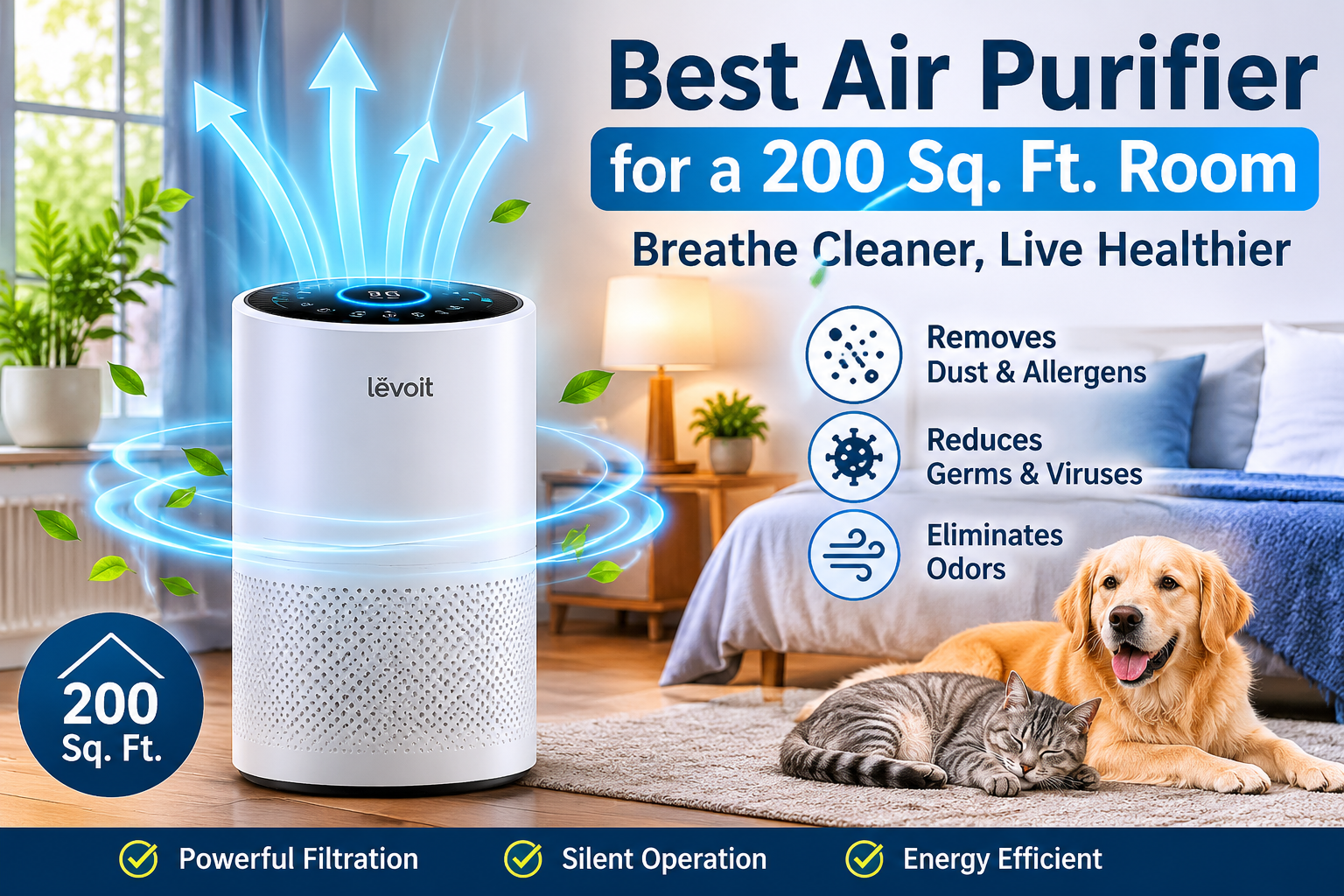
Finding the best air purifier for a 100 sq. ft. room is not just about choosing the smallest model or the one with the highest advertised coverage. For a small bedroom, you need enough clean-air delivery to reduce airborne particles without dealing with excessive fan noise, high electricity consumption, or expensive replacement filters.
A purifier that works well in a living room may be unnecessarily large for a small bedroom. On the other hand, an inexpensive desktop purifier may not deliver enough clean air to meet your expectations.
The key is to compare Clean Air Delivery Rate (CADR), room-size recommendations, low-speed performance, filtration technology, and long-term ownership costs.
This guide compares five compact air purifiers using current manufacturer specifications and available independent testing. It also explains how to calculate the CADR required for a 100-square-foot bedroom, what to look for in a quiet air purifier, and how to avoid common buying mistakes.
What Is the Best Air Purifier for a 100 Sq. Ft. Room?
For a 100-square-foot bedroom with an eight-foot ceiling, a smoke CADR of approximately 65 CFM is a useful starting point. ENERGY STAR provides this minimum sizing estimate for particle removal.
Several compact air purifiers exceed this threshold at their maximum fan settings. However, maximum CADR does not necessarily represent the performance you will get when using a quieter setting overnight.
Here are five models worth comparing:
Quick Comparison: Small Room Air Purifiers
| Air Purifier | Manufacturer Smoke CADR | Independent Low-Noise Result | Rated Power |
|---|---|---|---|
| Blueair Blue Pure 511 | 122 CFM | Not verified here | 16 W |
| Levoit Core 200S-P | 90 CFM | Not verified here | 37 W |
| Coway Airmega 100 | 108 CFM | Not verified here | 25 W |
| Dreo Air Purifier 338S | Not presented as a smoke CADR | 62 CFM PM1 CADR | Verify manufacturer documentation |
| Blueair Blue Pure 511i Max | 153 CFM | 95 CFM PM1 CADR | 17 W |
Important comparison note: Manufacturer smoke CADR and RTINGS’ independently measured PM1 CADR are different measurements. They should not be treated as directly interchangeable. Independent low-noise results are included only where a relevant test result is available.
How We Evaluated These Models
Our comparison focuses on five factors:
- Particle-cleaning performance and room suitability.
- Noise and usability in a bedroom.
- Filter design and maintenance.
- Energy consumption.
- Availability of verifiable specifications and independent testing.
Manufacturer specifications are identified separately from independent test results. We have not physically tested these five models, so this guide does not claim hands-on testing or laboratory measurements by BestAirPurifierOnline.com.
How Much CADR Do You Need for a 100 Sq. Ft. Room?
CADR stands for Clean Air Delivery Rate. It measures how quickly an air purifier delivers filtered air.
CADR is generally expressed in cubic feet per minute (CFM). A higher CADR means the purifier can deliver more clean air in a given amount of time.
For small bedrooms, CADR is one of the most useful specifications to compare because it helps determine whether a purifier is appropriately sized for the room.
The three commonly reported CADR categories are:
- Smoke
- Dust
- Pollen
Smoke CADR is particularly useful when comparing particle-removal performance.
Calculate the CADR for Your Bedroom
Room area is only one part of the calculation. Ceiling height also affects the total volume of air that needs to be filtered.
Consider a bedroom measuring 10 feet by 10 feet with an eight-foot ceiling.
Step 1: Calculate the floor area
10 × 10 = 100 square feet.
Step 2: Calculate the room volume
100 × 8 = 800 cubic feet.
Step 3: Select an air-change target
For this example, use 4.8 air changes per hour (ACH).
Step 4: Calculate the required CADR
CADR = (Room Volume × ACH) ÷ 60
CADR = (800 × 4.8) ÷ 60
Required CADR = 64 CFM.
Therefore, a purifier delivering approximately 64–65 CFM would meet this calculated target under the stated assumptions.
ENERGY STAR’s sizing guidance lists a minimum CADR of 65 CFM for a 100-square-foot room, based on an eight-foot ceiling.
Source: ENERGY STAR – Air Cleaners.
How Ceiling Height Changes Your CADR Requirement
A 100-square-foot bedroom with a 10-foot ceiling contains more air than a bedroom with an eight-foot ceiling.
| Ceiling Height | Room Volume | CADR for 4.8 ACH |
|---|---|---|
| 8 feet | 800 cu. ft. | 64 CFM |
| 9 feet | 900 cu. ft. | 72 CFM |
| 10 feet | 1,000 cu. ft. | 80 CFM |
This is why room coverage claims should not be interpreted without considering ceiling height.
Why Maximum CADR Is Not the Whole Story
Manufacturers commonly publish CADR at a specified testing condition. A purifier may deliver its highest airflow at maximum fan speed, but you may prefer a quieter setting in your bedroom.
For example, RTINGS measured the Dreo 338S at 115 CFM PM1 CADR at maximum speed and 62 CFM at its low-noise setting.
That difference matters. A purifier that meets your CADR target at maximum speed may not meet the same target when operated quietly.
For overnight use, compare both cleaning performance and noise whenever reliable low-noise testing is available.
Best Air Purifiers for Small Bedrooms: Product Comparison
The following models offer different combinations of airflow, filtration, controls, and size. They are not equally suitable for every bedroom, so consider your room conditions and preferred operating noise.
1. Blueair Blue Pure 511
Best for: Compact design and straightforward operation
The Blueair Blue Pure 511 is a compact air purifier designed for small rooms, bedrooms, and dorm rooms.
It uses Blueair’s HEPASilent technology, which combines mechanical and electrostatic filtration. The system includes a particle-and-carbon filter and a washable fabric pre-filter.
Manufacturer specifications
| Feature | Specification |
|---|---|
| Smoke CADR | 122 CFM |
| Dust CADR | 123 CFM |
| Pollen CADR | 123 CFM |
| Recommended room size | 189 sq. ft. |
| Noise level | 24–49 dB |
| Power consumption | 16 W |
| Filter replacement guidance | Approximately 6 months |
| Dimensions | 13.4 × 7.9 × 7.9 inches |
| Listed price | $99.99 |
Source: Blueair Blue Pure 511 – Official Product Page.
Why consider it?
The Blue Pure 511 has a small footprint and simple physical controls. Its published smoke CADR is comfortably above the 65 CFM sizing estimate for a 100-square-foot bedroom.
The manufacturer recommends replacing its filter approximately every six months.
Potential limitations
The standard Blue Pure 511 does not offer the same smart controls and built-in air-quality monitoring features as the 511i Max.
Also, maximum CADR does not establish the exact amount of clean air delivered at the lowest fan speed.
The manufacturer’s US page currently displays a restock notification, so check availability before purchasing.
Verdict: A practical option for buyers who prefer a compact purifier with simple controls and strong published CADR.
Official product: https://www.blueair.com/products/blue-pure-511
2. Levoit Core 200S-P
Best for: Smart controls and bedroom convenience
The Levoit Core 200S-P is a compact cylindrical air purifier with app connectivity, scheduling, and sleep mode.
Its filtration system uses a pre-filter, particle filtration media, and activated carbon. The 360-degree intake design allows air to enter from around the unit.
Manufacturer specifications
| Feature | Specification |
|---|---|
| Published CADR | 90 CFM |
| Ideal room size | 140 sq. ft. at 4.8 ACH |
| Noise level | 27–48 dB |
| Rated power | 37 W |
| Dimensions | 8.1 × 8.1 × 12.6 inches |
| Weight | 6.6 lb |
| Listed price | Check current manufacturer listing |
Source: Levoit Core 200S-P – Official Product Page.
Why consider it?
Its strongest selling point is convenience.
Through the VeSync app, users can adjust fan settings, create schedules, and manage the purifier remotely. It also supports voice control through compatible smart-home systems.
The manufacturer lists a noise range of 27–48 dB.
Important model and certification clarification
Levoit’s current product specification page uses the product title Core 200S-P but identifies the model in its specification section as CORE 200S.
An older ENERGY STAR record also identifies the model as Core 200S and lists 98 CFM smoke CADR, 109 CFM dust CADR, and 104 CFM pollen CADR. Those historical certification figures should not automatically be substituted for the current manufacturer’s 90 CFM specification.
The article therefore uses the current manufacturer’s published 90 CFM figure and does not claim a separate verified ENERGY STAR certification for a distinct Core 200S-P variant.
Sources:
Potential limitations
Its rated power consumption is higher than several other compact models in this comparison.
Before purchasing, check the exact model number and replacement filter compatibility.
Verdict: Worth considering if app control, scheduling, and smart-home convenience are priorities.
3. Coway Airmega 100
Best for: Automatic operation and particle monitoring
The Coway Airmega 100 combines a compact cylindrical design with a three-stage filtration system.
Its filter includes a vacuumable pre-filter, HEPA filtration, and a deodorization layer.
The purifier also includes a PM2.5 particle sensor and automatic operating mode.
Manufacturer specifications
| Feature | Specification |
|---|---|
| Smoke CADR | 108 CFM |
| Dust CADR | 124 CFM |
| Pollen CADR | 112 CFM |
| Coverage at 2 ACH | 405 sq. ft. |
| Noise level | 20–48 dB(A) |
| Power consumption | 25 W |
| Filter life expectancy | Up to 1 year |
| Dimensions | 8.7 × 15.6 × 8.7 inches |
| Listed price | $129.99 |
Source: Coway Airmega 100 – Official Product Page.
Why consider it?
The Airmega 100 offers relatively strong published CADR values for its size.
Its PM2.5 sensor can adjust fan operation according to detected particle levels. Automatic mode may be useful if you do not want to change fan settings manually throughout the day.
Potential limitations
Its advertised 405-square-foot coverage is based on two air changes per hour, not the 4.8 ACH target used in this guide.
This distinction matters when comparing room-size claims.
The manufacturer recommends a filter life expectancy of up to one year. Actual filter life depends on usage and indoor pollution levels.
Verdict: A useful candidate for buyers who want particle monitoring, automatic operation, and relatively high published CADR in a compact design.
4. Dreo Air Purifier 338S
Best for: Compact rooms and smart features
The Dreo Air Purifier 338S combines a compact cylindrical body with a three-stage HEPA filter, real-time PM2.5 monitoring, and smart controls.
It includes multiple fan speeds, automatic purification, and a built-in air-quality display.
Manufacturer specifications
| Feature | Specification |
|---|---|
| Maximum airflow | 115 CFM |
| Filter | 3-in-1 HEPA filter |
| Maximum advertised coverage | 856 sq. ft. |
| Fan speeds | 6 levels |
| Airflow modes | 4 |
| Listed price | $99.99 |
Source: Dreo Air Purifier 338S – Official Product Page.
What independent testing tells us
RTINGS independently tested the Dreo 338S and reported:
- Maximum measured PM1 CADR: 115 CFM.
- Low-noise measured PM1 CADR: 62 CFM.
- Lowest fan-speed noise: 31.2 dBA.
- Highest fan-speed noise: 56 dBA.
- Recommended low-noise room size: 97 sq. ft.
- Recommended room size at maximum fan speed: 180 sq. ft.
Source: RTINGS – Best Budget Air Purifiers.
These results are particularly relevant to a 100-square-foot bedroom.
At maximum speed, the purifier delivers considerably more airflow. However, in RTINGS’ low-noise test, its measured 62 CFM falls slightly below the 65 CFM sizing estimate for our example room.
That does not mean the purifier cannot be used in a 100-square-foot bedroom. It means buyers should understand the trade-off between quieter operation and cleaning performance.
Potential limitations
Its highest fan setting reaches 56 dBA in RTINGS’ testing, which may be distracting to people sensitive to fan noise.
RTINGS also notes that the carbon layer is limited for substantial odor removal.
Verdict: A compact option worth considering for smaller bedrooms, but its low-noise performance deserves particular attention.
5. Blueair Blue Pure 511i Max
Best for: Smart features and stronger low-noise filtration
The Blueair Blue Pure 511i Max builds on the compact design of the Blue Pure 511 with additional controls, sensors, and app connectivity.
It includes Night Mode, Auto Mode, Wi-Fi connectivity, and filter-life monitoring.
Manufacturer specifications
| Feature | Specification |
|---|---|
| Smoke CADR | 153 CFM |
| Dust CADR | 159 CFM |
| Pollen CADR | 174 CFM |
| Recommended room size | 237 sq. ft. |
| Noise level | 19–48 dB |
| Power consumption | 17 W |
| Filter life | Up to 9 months |
| Dimensions | 14.5 × 9.3 × 9.3 inches |
| Listed price | $139.99 |
Source: Blueair Blue Pure 511i Max – Official Product Page.
Independent testing
RTINGS tested the model and reported:
- Maximum measured PM1 CADR: 150 CFM.
- Low-noise measured PM1 CADR: 95 CFM.
- Lowest-speed noise: 30.8 dBA.
- Highest-speed noise: 53.9 dBA.
RTINGS also reported that its low-noise result was achieved using Speed 3 through the Blueair app.
Source: RTINGS – Blueair Blue Pure 511i Max Review.
This low-noise performance is particularly relevant to a 100-square-foot bedroom because its independently measured 95 CFM PM1 CADR is above the 65 CFM sizing estimate.
Why consider it?
Night Mode reduces fan speed and turns off display lights. App controls provide additional flexibility over fan settings and schedules.
The manufacturer lists filter life of up to nine months, although actual replacement timing depends on usage and pollution levels.
Potential limitations
It costs more than the standard Blue Pure 511.
Its current manufacturer page displays a restock notification, so buyers should verify availability.
Replacement filter prices vary by filter type. The manufacturer currently lists its standard Particle & Carbon filter subscription at approximately $51 per filter.
Verdict: A strong candidate for buyers who prioritize low-noise filtration and smart controls over the lowest initial purchase price.
How to Choose a Quiet Air Purifier for Sleeping
A bedroom air purifier needs to do more than move air. It must be comfortable enough to operate consistently.
Noise is one of the most important considerations.
Manufacturers usually publish sound levels in decibels (dB or dBA). However, a single noise figure does not tell you how well a purifier cleans the air at that setting.
For example, RTINGS measured the Dreo 338S at 62 CFM in its low-noise test and the Blueair 511i Max at 95 CFM in its low-noise test.
Both measurements are useful, but they come from different products and test conditions. They should not be treated as a direct standardized comparison.
What Noise Level Should You Look For?
There is no universal noise threshold that guarantees comfortable sleep.
Personal sensitivity, bedroom layout, background noise, and fan characteristics all influence how noticeable an appliance becomes.
When comparing products, look for:
- A genuinely quiet lowest fan setting.
- A dedicated sleep mode.
- The ability to turn off display lights.
- Independent noise measurements where available.
- Low-noise filtration performance rather than noise alone.
A purifier that is quiet but barely moves air may not provide the cleaning performance you expect.
HEPA vs. Activated Carbon: Which Filter Do You Need?
HEPA filtration and activated carbon perform different jobs.
Understanding this difference can prevent you from buying a purifier that does not address your primary indoor air quality concern.
What HEPA Filtration Captures
HEPA filters are designed to capture airborne particles.
These may include:
- Dust.
- Pollen.
- Pet dander.
- Mold spores.
- Smoke particles.
A filter’s effectiveness depends on the filtration media, installation, airflow, and overall purifier construction.
Do not assume that every product using the phrase “HEPA-type” has the same certification or performance as a certified HEPA filtration system.
What Activated Carbon Filters Do
Activated carbon is designed to adsorb certain gases and odors.
It may help reduce some household odors, cooking smells, and gaseous pollutants.
However, the amount of carbon matters.
A thin carbon-coated layer should not automatically be treated as equivalent to a substantial carbon bed.
The EPA explains that particle and gas filtration are separate functions. CADR measures particle removal, not general gas-removal performance.
Source: EPA – Guide to Air Cleaners in the Home.
Why You May Need Both
For a bedroom affected by dust and pollen, particle filtration should be the priority.
For a room with recurring household odors, an appropriate activated carbon filter may provide additional benefits.
Neither type of filter eliminates every indoor pollutant.
Source control, ventilation, and moisture management remain important.
Avoid Ozone-Generating Devices
Avoid air cleaners that intentionally generate ozone.
Ozone is a respiratory irritant. The EPA advises consumers to avoid ozone generators marketed as air cleaners.
Some electronic filtration technologies may also have ozone-emission considerations. Check product documentation and relevant safety information before purchasing.
Source: EPA – Guide to Air Cleaners in the Home.
How Much Does a Small Room Air Purifier Cost to Run?
The purchase price is only one part of the ownership cost.
Electricity and replacement filters can add significantly to the long-term expense.
Electricity Consumption
Use this formula:
Annual electricity consumption (kWh) = (Power in watts × Operating hours per day × 365) ÷ 1,000.
For example, a 16-watt air purifier running continuously uses:
(16 × 24 × 365) ÷ 1,000 = 140.16 kWh per year.
The following estimates assume continuous operation at the published rated power.
| Model | Rated Power | Estimated Annual Electricity |
|---|---|---|
| Blue Pure 511 | 16 W | 140.2 kWh |
| Blue Pure 511i Max | 17 W | 148.9 kWh |
| Coway Airmega 100 | 25 W | 219 kWh |
| Levoit Core 200S-P | 37 W | 324.1 kWh |
These are mathematical estimates, not measured annual consumption. Actual usage may be lower because fan speed, automatic operation, and operating conditions affect power draw.
Monthly and Annual Electricity Costs
Assume an electricity rate of $0.16 per kWh.
| Model | Estimated Monthly Cost | Estimated Annual Cost |
|---|---|---|
| Blue Pure 511 | $1.87 | $22.43 |
| Blue Pure 511i Max | $1.99 | $23.83 |
| Coway Airmega 100 | $2.92 | $35.04 |
| Levoit Core 200S-P | $4.32 | $51.86 |
Your actual electricity rate may differ. Replace $0.16 with the rate shown on your utility bill for a more accurate estimate.
Replacement Filter Costs
Filter replacement is another recurring expense.
| Model | Manufacturer Guidance | Filter Cost |
|---|---|---|
| Blue Pure 511 | About 6 months | Check current listing |
| Blue Pure 511i Max | Up to 9 months | Approximately $51 for the listed standard filter subscription |
| Levoit Core 200S-P | Follow manufacturer guidance | Verify current price |
| Coway Airmega 100 | Up to 1 year | Verify current price |
| Dreo 338S | Follow filter indicator and manual | Verify current price |
These are manufacturer guidance figures and indicative listings, not guaranteed future prices.
Filter life depends on indoor pollution, operating hours, and fan speed. Do not continue using a heavily loaded filter simply because its advertised replacement interval has not passed.
Why Total Ownership Cost Matters
A less expensive purifier can become more expensive to maintain if it requires frequent filter replacements.
Before buying, calculate:
- Initial purchase price.
- Expected annual electricity cost.
- Replacement filter cost.
- Replacement frequency.
- Warranty coverage.
Comparing these figures over three years gives a more realistic picture than looking at the purchase price alone.
Where Should You Place an Air Purifier in a Small Bedroom?
Even a well-sized purifier can perform poorly if its airflow is blocked.
Placement should allow the unit to draw in room air and release filtered air without obstruction.
Follow these practical guidelines:
- Keep the air intake clear.
- Do not place the unit directly against curtains.
- Follow the manufacturer’s wall-clearance instructions.
- Avoid covering the top air outlet.
- Place the purifier in the room where you spend the most time.
- Avoid positioning it where furniture blocks circulation.
If the purifier creates an uncomfortable draft near the bed, reposition it so the airflow is directed away from your sleeping area.
ENERGY STAR also recommends keeping air cleaners away from curtains and objects that obstruct airflow.
Source: ENERGY STAR – Air Cleaners.
Common Mistakes When Buying a 100 Sq. Ft. Air Purifier
1. Choosing Based Only on Room Coverage
A manufacturer may advertise coverage for a much larger room based on one air change per hour.
That does not mean the purifier will provide the same performance at four or five air changes per hour.
Always check the ACH assumption.
2. Ignoring Smoke CADR
A large room-size claim does not replace a verified CADR measurement.
Compare smoke CADR when your primary concern is fine particle removal.
3. Ignoring Low-Speed Performance
If you intend to use the purifier overnight, maximum CADR may be less relevant than the amount of clean air it delivers at a comfortable noise level.
4. Overlooking Replacement Filter Costs
A low purchase price can be misleading when replacement filters are expensive or difficult to find.
Check filter availability before purchasing.
5. Assuming Every HEPA Claim Means the Same Thing
Terms such as True HEPA, HEPA-type, and HEPA-grade should not be treated as interchangeable certification claims.
Read the manufacturer’s technical documentation.
6. Buying an Ozone Generator
Avoid products that intentionally generate ozone as a method of cleaning indoor air.
Frequently Asked Questions
1. Is an air purifier worth it for a 100 sq. ft. bedroom?
It can be useful if the room has recurring airborne particles such as dust, pollen, smoke, or pet dander.
The benefit depends on the purifier’s cleaning capacity, filter condition, operating time, and pollution sources.
2. What CADR is suitable for a 100 sq. ft. room?
ENERGY STAR lists 65 CFM as a minimum sizing estimate for a 100-square-foot room with an eight-foot ceiling.
A higher CADR may be useful if you want faster particle removal or have a higher ceiling.
3. Can a small air purifier clean a bedroom effectively?
Yes, provided its clean air delivery rate is appropriate for the room’s volume.
A compact purifier can work well in a small bedroom, but physical size alone does not determine cleaning performance.
4. Should I leave an air purifier running overnight?
Continuous operation can help maintain cleaner air, particularly when indoor pollution sources remain present.
Choose a model with an appropriate low-noise setting and follow its operating instructions.
5. What is the quietest air purifier for a small bedroom?
Noise measurements depend on fan speed and testing conditions.
The Blueair Blue Pure 511i Max has a manufacturer-listed sound range of 19–48 dB. RTINGS measured 30.8 dBA at its lowest fan speed and reported a low-noise PM1 CADR of 95 CFM in its testing.
6. Does a HEPA filter remove odors?
A particle filter alone is not designed to remove most gases and odors.
For certain odors and gaseous pollutants, choose a purifier with an appropriately designed activated carbon filter.
7. How often should I replace a small air purifier filter?
Follow the manufacturer’s recommended interval and filter indicator.
Some models recommend replacement every six months, while others advertise intervals of up to nine or twelve months. Actual filter life depends on pollution levels and usage.
8. How much electricity does a small air purifier use?
It depends on rated power and operating hours.
A 16-watt purifier running continuously uses approximately 140 kWh per year. At $0.16 per kWh, that is approximately $22.43 annually.
9. Where should I put an air purifier in a small bedroom?
Place it where its intake and outlet have adequate clearance.
Avoid blocking it with furniture, curtains, bedding, or other objects. Follow the manufacturer’s placement instructions.
10. Can an air purifier remove all indoor dust?
No. Air purifiers can capture airborne dust particles, but they cannot prevent all dust from entering or settling in a room.
Regular cleaning, source control, and appropriate ventilation remain important.
Final Verdict: Choosing the Right Air Purifier for Your Small Bedroom
The best air purifier for a 100-square-foot bedroom is not necessarily the one with the highest advertised room coverage or the lowest purchase price.
Start with the room’s dimensions and ceiling height. Look for sufficient smoke CADR, then consider how much filtration the unit can deliver at a noise level you can tolerate while sleeping.
Among the products examined here:
- Blueair Blue Pure 511: A compact option with straightforward controls and strong published CADR for its size.
- Levoit Core 200S-P: Worth considering if app control and scheduling are important.
- Coway Airmega 100: Offers a useful combination of particle sensing, automatic operation, and published CADR.
- Dreo 338S: A compact choice, but its low-noise performance is close to the calculated requirement for a 100-square-foot room.
- Blueair Blue Pure 511i Max: Particularly interesting for buyers who want strong low-noise filtration and smart controls.
Before purchasing, compare the latest product specifications, replacement filter prices, and availability from the manufacturer.
A well-sized purifier that you can comfortably operate every day is generally a more practical choice than a powerful model that becomes too noisy to use.
Suggested Internal Links
Use these internal links when the corresponding pages are available on BestAirPurifierOnline.com.
| Suggested Anchor Text | Recommended Destination |
|---|---|
| Air Purifier Buying Guide | Main buying guide |
| HEPA Filter Guide | HEPA filtration educational article |
| CADR Calculator | Interactive CADR calculator |
| Air Purifier Room Size Guide | Room sizing guide |
| Best Air Purifier for Allergies | Allergy-focused buying guide |
| Air Purifier Maintenance Guide | Filter cleaning and replacement guide |
| Air Purifier Electricity Cost Calculator | Electricity calculator |
| Air Purifier Comparison Tool | Product comparison tool |
Suggested Images and Alt Text
- Hero image: Compact air purifier in a small modern bedroom.
Alt text:Compact air purifier placed in a 100 square foot bedroom - CADR infographic: How room volume and ACH determine required CADR.
Alt text:CADR calculation for a 100 square foot bedroom with an 8 foot ceiling - Comparison image: Five compact air purifiers in a clean comparison layout.
Alt text:Comparison of five compact air purifiers for small bedrooms - Filtration diagram: Pre-filter, HEPA filtration media, and activated carbon.
Alt text:Air purifier filtration stages including pre-filter HEPA and activated carbon - Placement illustration: Correct and incorrect purifier placement in a bedroom.
Alt text:Correct air purifier placement with unobstructed airflow in a bedroom - Cost chart: Estimated annual electricity consumption by rated power.
Alt text:Estimated annual electricity consumption of small room air purifiers
Affiliate Disclosure
Place this disclosure near the beginning of the article, before the first affiliate product link:
BestAirPurifierOnline.com may earn a commission when readers purchase products through qualifying affiliate links. This does not increase the purchase price paid by the customer. Our product comparisons are based on available specifications, research, and editorial evaluation.
Sources and References
Government and Industry Sources
- US Environmental Protection Agency – Guide to Air Cleaners in the Home
- ENERGY STAR – Air Cleaners
- ENERGY STAR – Room Air Cleaner Key Product Criteria
Manufacturer Product Documentation
- Blueair Blue Pure 511
- Levoit Core 200S-P
- Coway Airmega 100
- Dreo Air Purifier 338S
- Blueair Blue Pure 511i Max
Independent Testing
- RTINGS – Best Air Purifiers for Bedrooms
- RTINGS – Best Budget Air Purifiers
- RTINGS – Blueair Blue Pure 511i Max Review
Editorial and Fact-Checking Notes
Product prices, specifications, availability, and replacement filter costs can change. Verify current manufacturer information before publishing.
This article is based on available manufacturer specifications and independent testing. BestAirPurifierOnline.com has not physically tested these five products.
The electricity cost calculations are estimates based on rated power, continuous operation, and an assumed rate of $0.16 per kWh. They are not measured annual electricity consumption figures.