What Is ACH (Air Changes per Hour)? A Complete Guide
By Kamal Kishor Raika
When choosing an air purifier, you may come across a specification called ACH, or Air Changes per Hour. It is often used to explain how frequently the air in a room is filtered or circulated.
But what does ACH actually mean? Is a higher ACH always better? And how can you calculate the ACH of an air purifier for your bedroom or living room?
ACH is a measurement that describes how many equivalent room volumes of air are supplied, exhausted, or cleaned in one hour. For air purifiers, it is commonly used to estimate how much filtered air a device delivers relative to the size of a room.
Understanding ACH can help you compare air purifiers, evaluate room coverage, and choose a device that matches your indoor air quality needs.
In this guide, we will explain what ACH means, how to calculate it using CADR, how it differs from eACH and CADR, and what to consider before choosing an air purifier.
What Is ACH (Air Changes per Hour)?
ACH stands for Air Changes per Hour.
It describes how many times an amount of air equal to the total volume of a room is supplied, exhausted, or processed in one hour.
For example, if a room has an ACH of 5, the airflow or clean-air delivery rate is equivalent to five times the room’s volume per hour.
However, this does not mean that every molecule of air in the room is completely replaced five times.
Air does not always mix perfectly. Some areas may receive more airflow than others, depending on the room layout, furniture, purifier placement, and ventilation system.
For portable air purifiers, ACH is especially useful because it helps relate the purifier’s clean air delivery rate to the room’s total air volume.
How Does ACH Work?
Imagine a bedroom with an air purifier operating continuously.
The purifier pulls indoor air through its filters, captures certain airborne pollutants, and releases treated air back into the room.
As this process continues, the purifier delivers more filtered air.
The relationship between clean air delivery and room volume determines the equivalent air changes per hour.
Consider two rooms:
- Room A has a volume of 1,000 cubic feet.
- Room B has a volume of 2,000 cubic feet.
If the same purifier delivers 1,000 cubic feet of clean air per hour, its equivalent air-change rate will be higher in Room A.
This is why the same air purifier can provide different ACH values in different rooms.
A larger room generally needs a higher clean air delivery rate to achieve the same equivalent ACH.
How to Calculate Air Changes per Hour
You can estimate the equivalent ACH of an air purifier using its CADR rating and the room’s volume.
Formula:
ACH = (CADR × 60) ÷ Room Volume
Where:
- CADR is measured in cubic feet per minute (CFM).
- 60 represents the number of minutes in an hour.
- Room Volume is measured in cubic feet.
First, calculate the room volume:
Room Volume = Length × Width × Ceiling Height
Then use the CADR formula to estimate the equivalent air changes per hour.
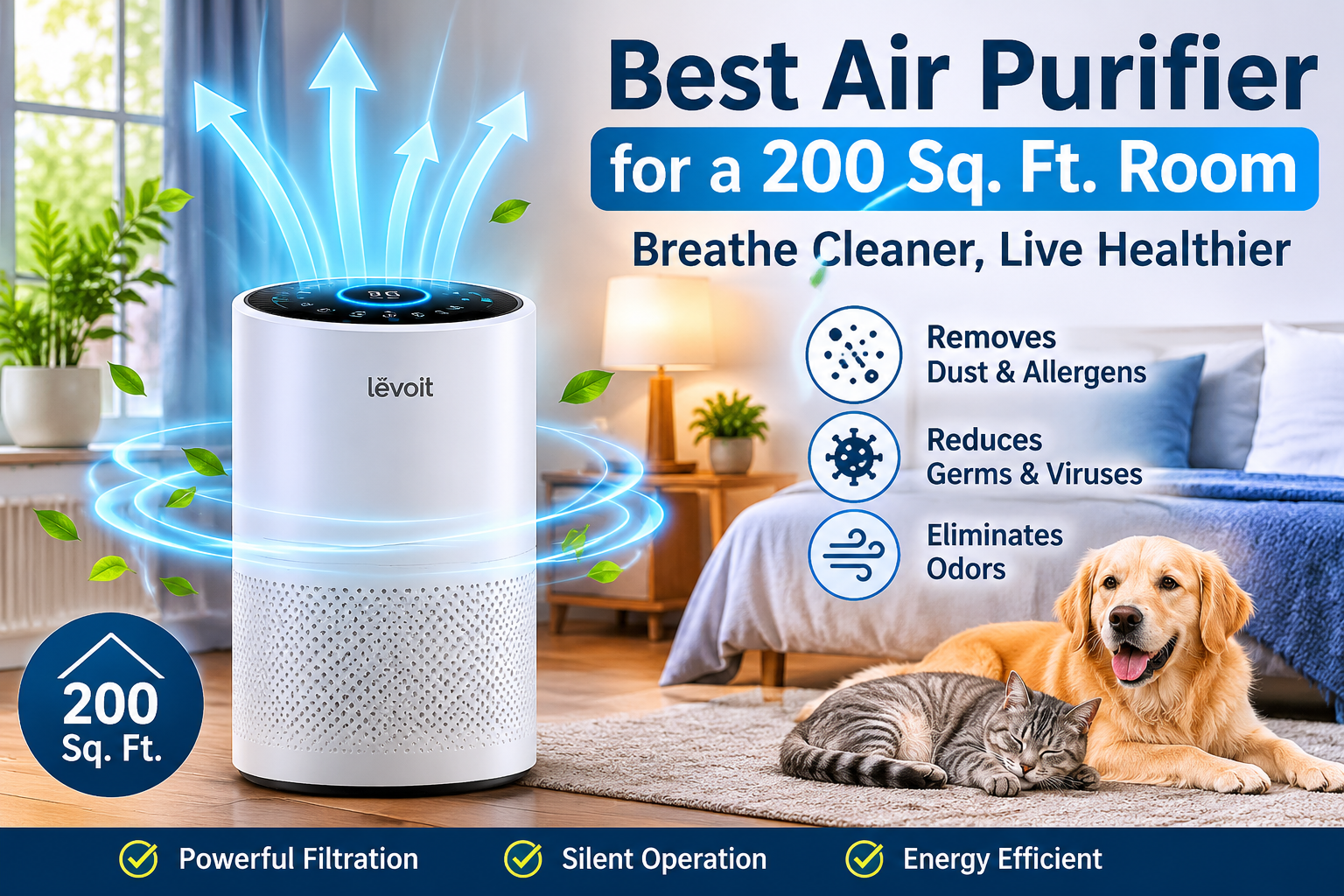
Example 1: A 200 Sq. Ft. Bedroom
Suppose your bedroom has the following dimensions:
- Length: 10 feet
- Width: 20 feet
- Ceiling Height: 8 feet
- Air Purifier CADR: 200 CFM
Step 1: Calculate Room Volume
10 × 20 × 8 = 1,600 cubic feet
Step 2: Calculate ACH
ACH = (200 × 60) ÷ 1,600
ACH = 12,000 ÷ 1,600
Estimated ACH = 7.5
This means the purifier delivers an equivalent clean-air volume of 7.5 room volumes per hour, based on the stated CADR.
Example 2: A 300 Sq. Ft. Living Room
Suppose your living room measures:
- Length: 15 feet
- Width: 20 feet
- Ceiling Height: 8 feet
- Air Purifier CADR: 200 CFM
Step 1: Calculate Room Volume
15 × 20 × 8 = 2,400 cubic feet
Step 2: Calculate ACH
ACH = (200 × 60) ÷ 2,400
ACH = 12,000 ÷ 2,400
Estimated ACH = 5
The same purifier delivers a lower equivalent ACH in this larger room.
This demonstrates why room size matters when choosing an air purifier.
What Is a Good ACH for an Air Purifier?
There is no single ACH value that is ideal for every home or situation.
The appropriate clean-air delivery rate depends on several factors:
- Room size and ceiling height
- Number of people in the room
- Indoor pollution sources
- Outdoor air quality
- Ventilation conditions
- The purpose of air cleaning
- Noise and energy considerations
AHAM’s suggested room-size ratings for portable air cleaners are based on approximately 4.8 equivalent air changes per hour under its stated room assumptions.
CDC/NIOSH also discusses aiming for at least 5 air changes per hour where possible as a practical ventilation and air-cleaning target for reducing airborne respiratory particles in indoor spaces.
These recommendations have different contexts and should not be treated as universal requirements for every home.
Residential Air Purifiers
For home use, look for a purifier with sufficient CADR for the room you want to clean.
A suitable clean-air delivery rate can help reduce airborne particles over time.
If your home experiences smoke, dust, or pollen problems, consider the relevant particle CADR rating rather than relying only on the advertised ACH.
Offices and Shared Indoor Spaces
Rooms with more occupants may require greater attention to ventilation and filtration.
Occupancy, activity levels, room layout, and outdoor air supply all influence indoor air quality.
In shared spaces, ventilation improvements and appropriately sized air cleaners can work together.
Healthcare and Specialized Environments
Healthcare environments may have specific ventilation and air-change requirements based on room function and applicable standards.
These requirements should not be applied directly to ordinary residential air purifiers without considering the relevant engineering guidance.
ACH vs. eACH: What’s the Difference?
ACH and eACH are related concepts, but they are not always interchangeable.
eACH means Equivalent Air Changes per Hour.
It expresses the contribution of clean air delivery from different sources, including filtered air, in terms of equivalent room-volume air changes.
| Feature | ACH | eACH |
|---|---|---|
| Full Form | Air Changes per Hour | Equivalent Air Changes per Hour |
| Main Meaning | Airflow or air-change rate relative to room volume | Equivalent clean-air delivery relative to room volume |
| Common Application | Ventilation and air exchange | Comparing combined clean-air contributions |
| Includes Filtration | Not necessarily | Can include filtered air |
| Main Consideration | Actual air supply or exhaust | Clean-air delivery from different methods |
For example, a room may receive outdoor air through ventilation and also use a HEPA air purifier.
The outdoor air and filtered air can both contribute to reducing airborne particle concentrations, but they work differently.
An air purifier recirculates and filters existing indoor air. It does not automatically provide fresh outdoor air.
This distinction matters because filtration may capture particles but does not necessarily remove gases and chemical vapors in the same way that outdoor air ventilation can dilute indoor pollutants.
ACH vs. CADR: Understanding the Difference
CADR and ACH are closely connected, but they measure different things.
CADR measures how much clean air an air purifier delivers per minute for specific particle categories.
ACH describes the equivalent number of room volumes of air delivered per hour.
| Feature | CADR | ACH |
|---|---|---|
| Full Form | Clean Air Delivery Rate | Air Changes per Hour |
| Measurement | CFM | Changes per hour |
| Main Purpose | Measures clean air delivery | Relates clean-air volume to room volume |
| Depends On | Airflow and particle-removal performance | CADR and room volume |
| Common Use | Comparing air purifier performance | Estimating room air-cleaning rate |
A purifier with a higher CADR will generally produce a higher equivalent ACH in the same room.
However, the same purifier will deliver a lower ACH in a larger room.
To understand CADR in more detail, read our guide: What Is CADR in Air Purifiers? Understanding Clean Air Delivery Rate.
Factors That Affect ACH
Several factors influence how much clean air an air purifier delivers relative to room volume.
1. Room Size
Room volume is one of the most important variables.
A purifier that delivers sufficient clean air in a small bedroom may be undersized for a large living room.
Always consider ceiling height as well as floor area.
2. Air Purifier CADR
A higher CADR generally provides more clean air delivery per minute.
This can increase the equivalent ACH for a room of a given volume.
Check the relevant smoke, dust, and pollen CADR ratings when comparing products.
3. Fan Speed
Many air purifiers offer multiple operating speeds.
Higher fan speeds usually increase airflow and clean air delivery, while lower speeds may be quieter but provide less filtration capacity.
If you calculate ACH using the maximum CADR, remember that the purifier may not deliver that rate at its quietest setting.
4. Filter Condition
Filters collect particles during operation.
As a filter becomes loaded with dust and other particles, airflow may be affected depending on the filter design and purifier.
Follow the manufacturer’s cleaning and replacement instructions to maintain appropriate performance.
5. Purifier Placement
Placement can influence how effectively air circulates through a room.
Avoid blocking the intake or outlet with furniture, curtains, or other objects.
Follow the manufacturer’s recommended clearance distances.
6. Doors and Windows
Open doors and windows can change indoor airflow and introduce additional outdoor pollutants.
This may affect how quickly a purifier can reduce indoor particle concentrations.
The result depends on outdoor conditions, ventilation patterns, and the location of the purifier.
7. Continuous Pollution Sources
Activities such as cooking, smoking, cleaning, and construction can generate airborne pollutants.
When new particles continuously enter the room, the purifier must work against both existing pollution and new emissions.
Source control remains important.
Does Higher ACH Always Mean Better Air Quality?
A higher equivalent ACH can help deliver clean air more frequently, but it does not automatically guarantee better overall indoor air quality.
Consider these practical factors.
Noise Levels
Higher fan speeds may increase noise.
A purifier with a high maximum ACH might be uncomfortable to operate continuously at its highest setting in a bedroom.
Compare noise levels at the speeds you are likely to use.
Energy Consumption
Continuous operation can affect electricity costs.
Look for energy-efficient models that provide suitable clean-air delivery for your room.
Filter Replacement Costs
More filtration can mean more particle loading on filters.
Check replacement filter prices, availability, and maintenance instructions before purchasing.
Pollutant Type
ACH calculations based on particle CADR do not describe every pollutant.
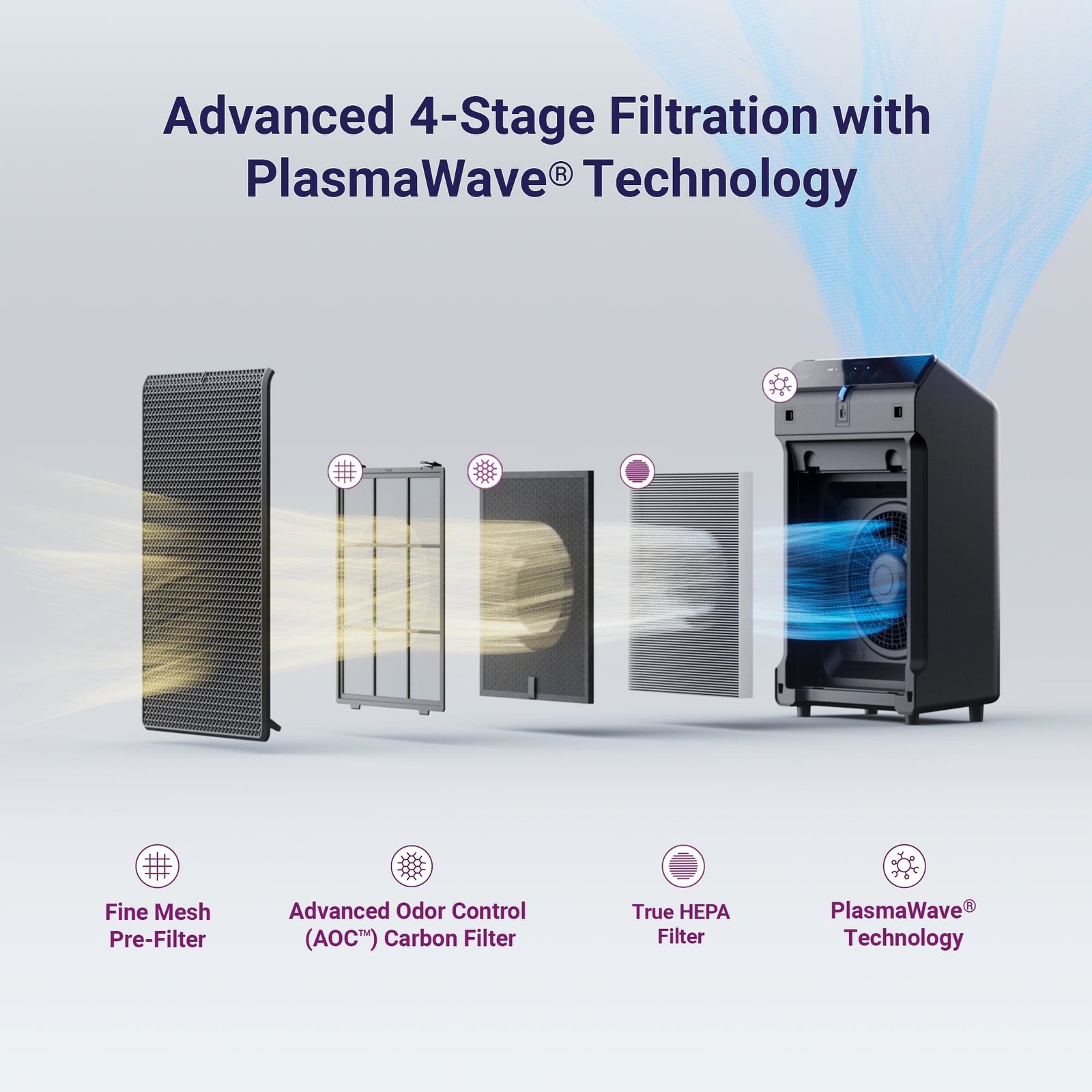
A HEPA filter can capture airborne particles, while reducing certain gases and odors generally requires activated carbon or other suitable gas-phase filtration media.
Real-World Air Mixing
A mathematical ACH calculation assumes that the delivered clean air is effectively distributed through the room.
In reality, airflow can be uneven.
Furniture, room geometry, placement, and obstructions may create areas with less effective circulation.
Common ACH Misconceptions
Myth 1: Five ACH Means All Room Air Is Completely Replaced Five Times
Fact: ACH describes an equivalent volume of air delivered relative to room volume. It does not mean every air molecule is completely replaced.
Myth 2: ACH and Ventilation Are the Same Thing
Fact: Ventilation involves supplying and exhausting air, often with outdoor air. A portable purifier generally recirculates and filters indoor air.
Myth 3: Higher ACH Always Means a Better Air Purifier
Fact: A higher equivalent ACH can be useful, but noise, energy consumption, filter costs, and pollutant type also matter.
Myth 4: Every Air Purifier Provides Its Advertised ACH in Every Room
Fact: Equivalent ACH depends on CADR and room volume. A purifier’s performance will vary with room size and operating conditions.
Myth 5: ACH Tells You How Well a Filter Removes Chemicals
Fact: Particle-based ACH calculations do not establish gas or VOC removal performance. Check the gas-phase filtration specifications separately.
Frequently Asked Questions
1. What does ACH mean in an air purifier?
ACH means Air Changes per Hour. It describes how many equivalent room volumes of clean air an air purifier delivers in one hour relative to the room’s total air volume.
2. How do I calculate ACH for an air purifier?
Calculate the room volume in cubic feet, multiply the purifier’s CADR in CFM by 60, and divide the result by the room volume.
Formula: ACH = (CADR × 60) ÷ Room Volume.
3. What is a good ACH for a bedroom?
There is no universal ACH requirement for every bedroom. Choose an air purifier with a CADR appropriate for the bedroom’s volume and your air-cleaning needs. AHAM’s suggested room-size ratings use approximately 4.8 equivalent air changes per hour under specified assumptions.
4. Is 5 ACH good?
Five ACH is a commonly discussed target in ventilation and airborne particle reduction guidance. However, its suitability depends on the building, room use, ventilation, and air-cleaning method. It is not a universal requirement for every home.
5. What is the difference between ACH and CADR?
CADR measures clean air delivery per minute for specific particle categories. ACH relates that clean-air delivery to the room’s total volume over one hour.
6. Does a higher ACH clean air faster?
A higher equivalent ACH generally means more clean air is delivered relative to room volume. However, actual pollutant reduction also depends on airflow mixing, filter performance, and ongoing pollution sources.
7. Can I calculate ACH without knowing the room height?
You need room volume to calculate ACH accurately. If you know only the floor area, you must also know or estimate ceiling height.
8. Does an air purifier provide fresh air?
Most portable air purifiers recirculate and filter existing indoor air. They do not normally bring fresh outdoor air into a room.
9. Can two air purifiers increase ACH?
Yes. If two purifiers operate in the same room, their clean-air delivery rates can generally be added to estimate the combined equivalent ACH, provided the ratings are applicable to the operating conditions. Actual room performance still depends on air circulation and placement.
10. Is ACH the same as eACH?
Not necessarily. ACH can describe ventilation or air exchange, while eACH expresses equivalent clean-air delivery from filtration and other air-cleaning methods in room-volume terms.
Final Thoughts
ACH is a useful concept for understanding how much clean air an air purifier delivers relative to the size of a room.
It helps explain why the same purifier can perform differently in a small bedroom and a large living room.
When selecting an air purifier, consider its CADR, room volume, filter type, operating noise, and maintenance requirements. Do not rely only on advertised ACH figures without understanding how they were calculated.
Remember that filtration and ventilation are complementary strategies. A suitable air purifier can reduce certain airborne particles, while proper ventilation and source control help address other indoor air quality concerns.
At BestAirPurifierOnline.com, our goal is to make air purification specifications easier to understand so you can choose products based on performance, evidence, and your actual needs.
SEO Publishing Details
SEO Title: What Is ACH in Air Purifiers? Air Changes per Hour Explained
Meta Description: Learn what ACH (Air Changes per Hour) means, how to calculate it using CADR and room size, and understand the difference between ACH and eACH.
URL Slug: air-changes-per-hour-ach
Focus Keyword: air changes per hour
Suggested Tags: Air Changes per Hour, ACH, eACH, CADR, Air Purifier Education, Indoor Air Quality
Featured Image File Name: air-changes-per-hour-ach-guide.webp
Featured Image Alt Text: Educational illustration explaining air changes per hour using an air purifier and room airflow.
Author: Kamal Kishor Raika